

Custdev for an Online Psychology Project
How to get accurate information about an audience and use it to build a product: 15 interviews, 148 surveys, a dashboard and a product framework

About the project
In this piece I'll walk through how we ran a full, by-the-book custdev, what results we got, and give you a step-by-step methodology to run one yourself. The methodology itself, as a standalone how-to, is in the article "How to Run a Custdev: A Step-by-Step Guide".
Customer development ("custdev" for short) is a market research method for building a product hypothesis.
We're building a psychology project for women going through a breakup. Part of the path was already covered: we'd found the market's problem, and found resonance with the audience. Sales were low. So we decided to run a custdev, to get more information and rebuild the entire product from scratch.
We ran 15 interviews. 148 people took part in the survey. Project team: Yulia Terentyeva, Svetlana Salikhova, Anastasia Derevyanko, Olesya Ryzhenko.
Selling in a soft niche
Producer teams sometimes run a shortened version of custdev — a couple of interviews or a single questionnaire — but that's a different kind of research. Only a full custdev gives you solid knowledge about the audience. After a custdev, you have a much better shot at building a product that hits users right in the heart.
As a rule, selling info-products in a soft niche requires a long communication cycle. The buyer gets used to the author, comes to agree with their values, builds trust, or finds a community of interest. To sell the product, you need to nail the target image precisely and identify the end result buyers actually want.
The target image is easy to describe in a hard niche: this much in this amount of time. In psychology, everything is different: there are a thousand and one ways to phrase the result, and each one is technically correct. But none of them sell, because the audience calls that result something of their own, in some particular tone.
An expert in a soft niche finds their way to the audience through words, through images and associations people understand, through a comfortable pace and a convenient process. You can feel your way to all of this through trial and error, over a couple of years of work — or you can run a custdev.
We'll cover the launch and warm-up scheme for this project in more detail in another piece.
An expert cannot put the ideal result into words the way a client would.
Our expert is an experienced psychologist, so her phrasing of the result was crisp: the person will step out of the victim role, take responsibility for their life, set personal boundaries, and go on to build new relationships from a place of stable self-esteem. That's roughly how any experienced psychologist would describe the result.
But guess how many people we'd get to sign up for a webinar if we offered them an exit from the victim role? Actually, no need to guess — we have the test results.
Subscribers were coming in through funnels like:
- how to get through a breakup,
- how to get over an ex,
- how to forgive infidelity.
This was quality traffic — people actively joined the chat and shared their stories. They responded well to the psychologist and showed up for the webinars. So the demand was clearly there, and all we had left to figure out was exactly what it was. What did they want, what result should we be leading them to? And how did they plan to get to that ideal result?
Stage 0. Setting the research goals
Deciding what information we want to get.
Identify the reason for low product sales. What expectations and requirements does the audience have for a product that could solve their problem — getting through a breakup with a partner.
Preparing a custdev starts with formulating the main hypothesis, which becomes the anchor for the whole study. Getting the custdev's goals right sets the direction for the entire research.
Next, we define the audience and the order in which the custdev will run.
Main hypothesis to test:
It's important to our audience to be able to manage their own life (not fall back into a painful relationship situation) and take responsibility for their life, so they can let go of the past and build new relationships. But they have requirements for the learning experience: comfort and a warm atmosphere, free of aggression.
We wanted to understand why the product wasn't selling, how to tighten up the offer, whether the product format needed to change, or maybe people were expecting a different kind of solution to this set of problems altogether. In terms of concrete tasks, that looked roughly like this:
- find out how consumers phrase the problem
- learn what results they expect from a solution
- find out what tools they tend to use to solve it
- find the optimal product format
- identify the factors that influence the purchase decision
Stage 1. Interview preparation
Defining the audience and building the script.
We already had a subscriber base and a base of marathon buyers. That made things easier — we weren't starting from a blank slate, and we knew who to ask. On the other hand, this was already a custdev with elements of a product experiment: we were essentially testing a ready-made solution in the form of an online course. At the start of a project, this is not recommended — a ready-made solution narrows the scope of the research.
Building the interview
First we prepared descriptions of the segments for the interviews — there were 2 segments: people who had bought the marathon or course, and people who hadn't bought anything. We wrote the interview script separately for each segment. It was important to check whether the audience matched the personas we'd written up (spoiler: it matched down to the details).
Questions need to sound natural, without any formality. First you need to get the person talking, set a trusting tone, and only then start extracting information.
We had a table with the audience personas laid out. During the interview, our assumptions about the audience collide with reality. We write down in advance the statements we want to test. For example:
- Depending on their intellectual interests and education, the audience will have different requests for the product.
- It's important to the audience to become the mistress of her own life.
- Our audience mostly got their information on the topic for free.
The interview guide is available at this link >>>
The interview script itself is built from blocks: qualification questions, personal background, phrasing and describing the problem, searching for solutions, questions to detail the solution.
The interview script is available at this link >>>
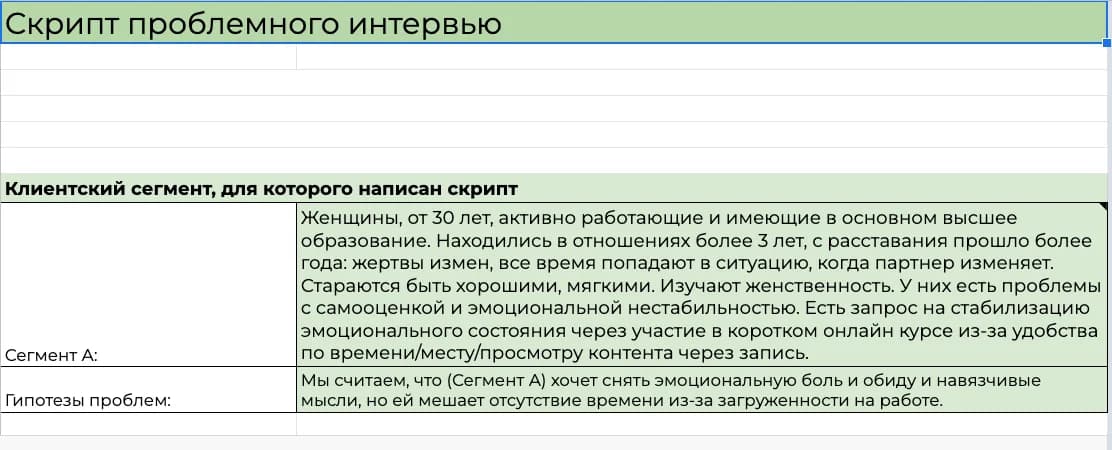
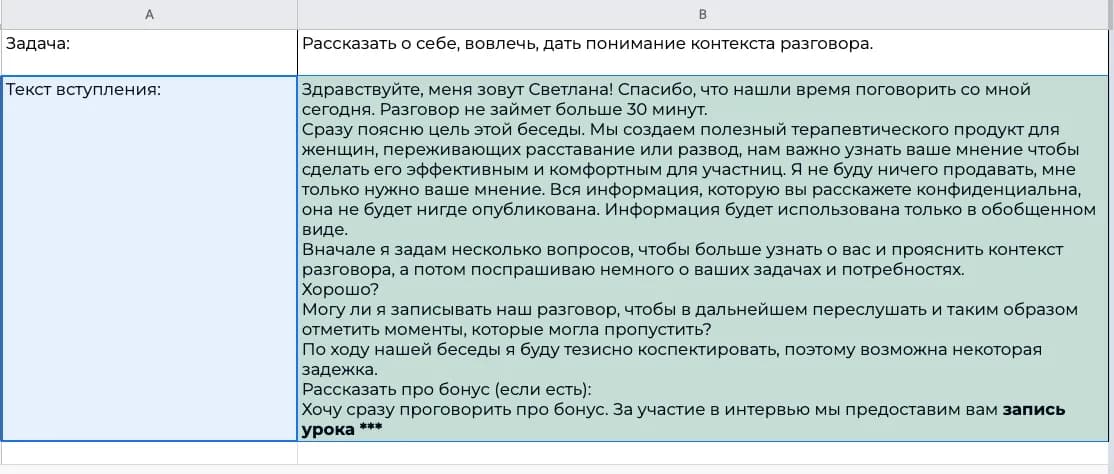
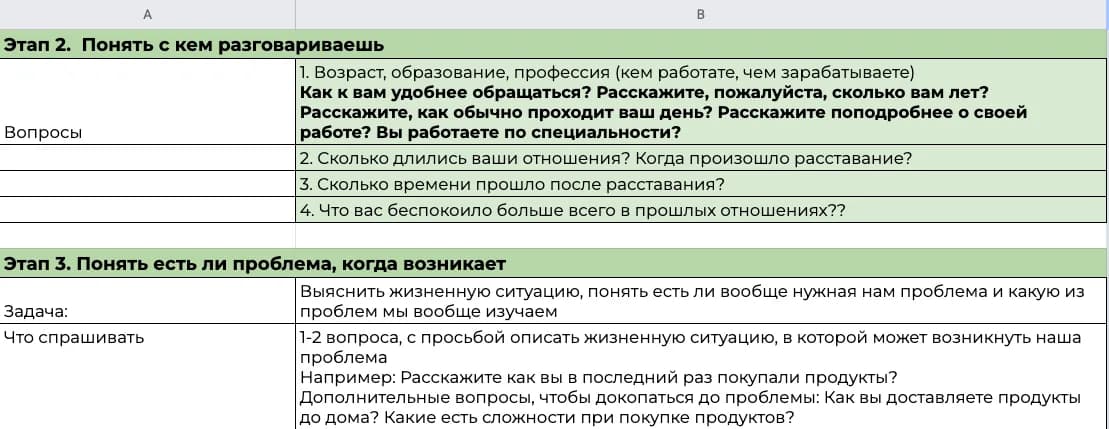
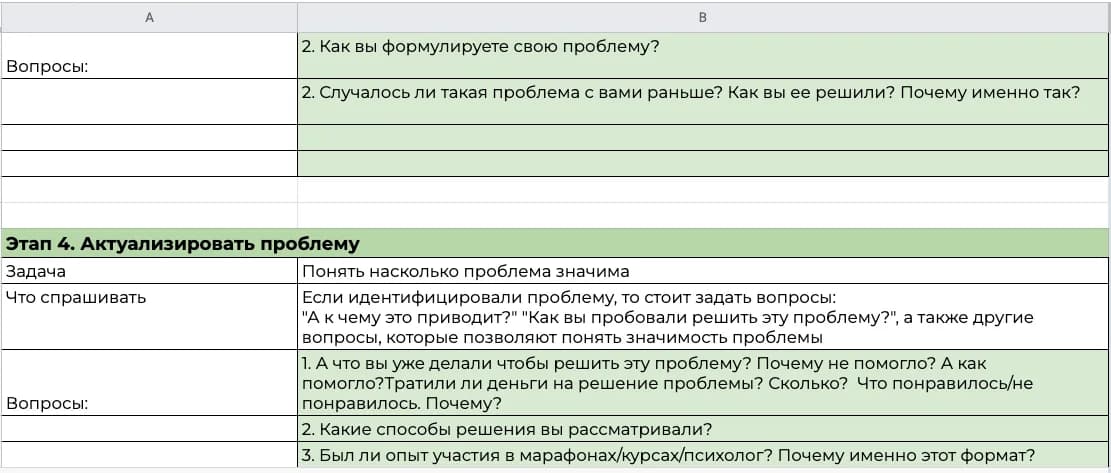
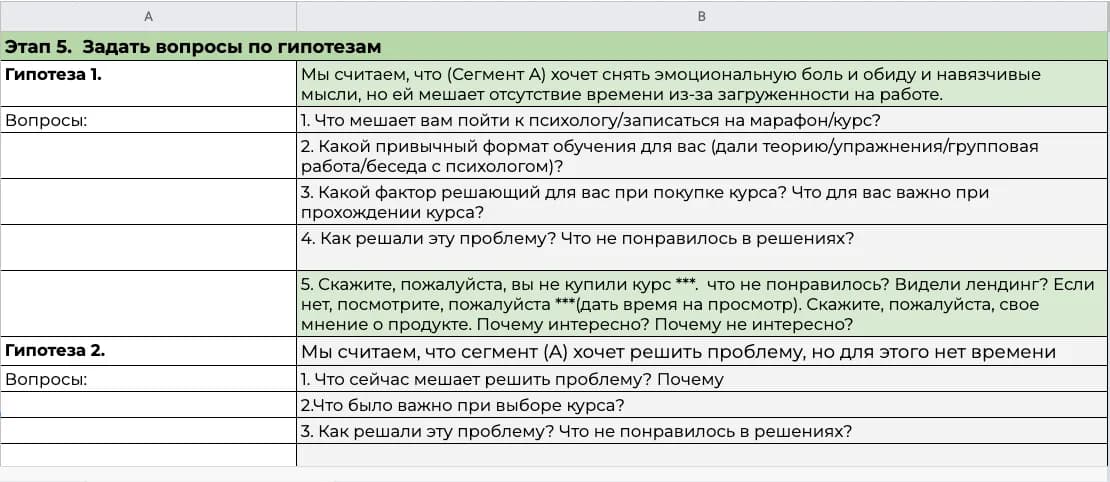
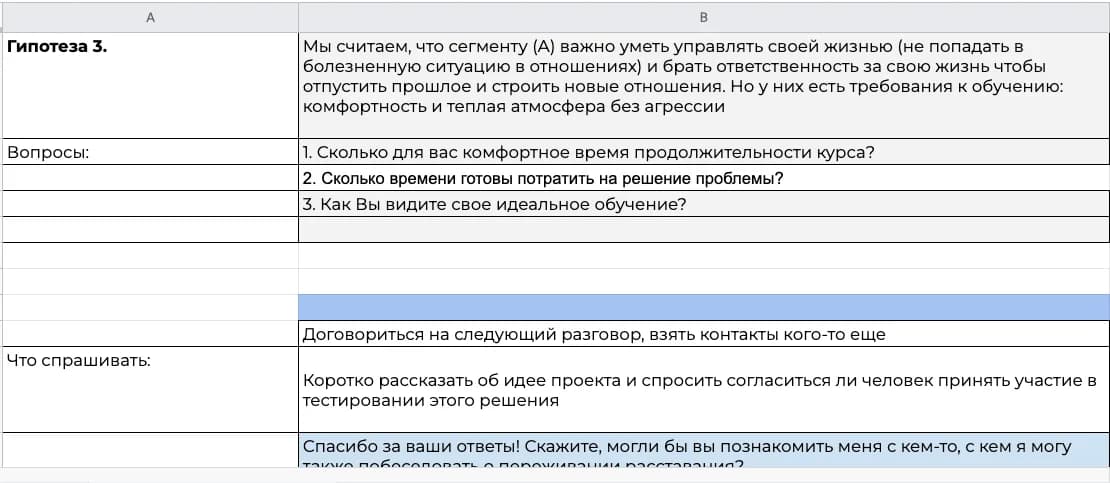
Problem interview script: client segment and problem hypotheses
Each interviewer needs to inject as little of their own personal input into the conversation as possible, while still earning trust and getting the person talking. Not an easy task.
Three people would be conducting interviews, and we understood we had a risk factor — the interviewer's personality. Three different people would run the conversation differently, drawing out different depth and tone. And there's a lot of nuance in how you run an interview.
We got on a call, aligned on the goals and phrasing, and agreed on how we'd collect and interpret the information. We went through every block of questions and discussed which ones we could ask, and how to steer the conversation where it needed to go. You can't ask point-blank: you recently broke up with your partner, how do you feel about that and what do you want? You need to gently draw the respondent out, and only then write down what they say, without steering them.
A single interview script turned out not to be enough, so a guide was born out of it. A useful thing.
Stage 2. Conducting and processing the interviews
Meetings, interpreting the answers, and the overlap map.
Each interview is conducted one on one, and the conversation takes 20–30 minutes. Meetings are scheduled in advance, and ideally the schedule isn't too tight — the interviewer needs time to get into the right headspace. We had 3 interviewers, 5 meetings each.
After the meetings, we transcribed the interviews and collected the overlaps: matching meanings, where respondents were talking about the same thing.
We ended up with several categories of overlaps:
- Problem description: precise phrasing and emphasis matter most here
- Description of needs: these later become the product's results
- Solution options: here we got a whole list of competitor names and ways of solving the problem, which also came in handy for building the product
- Preferences for the learning experience: this information relates to the course we developed; in a classic custdev this category isn't needed
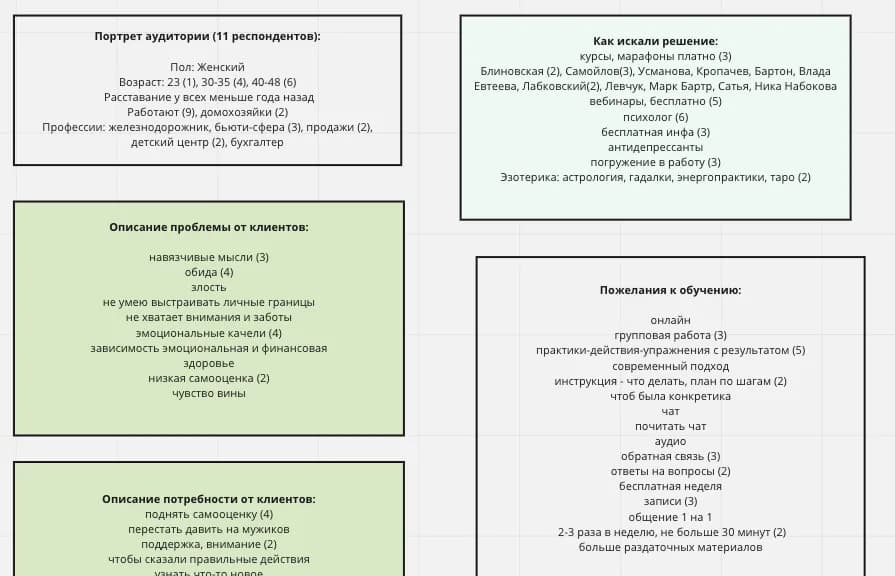
Three things matter when processing interviews: the respondent's exact wording, the interviewer's conclusions, and the overlaps in ideas and phrasing across different interviews.
We sent out mailings to 2 segments, inviting people to take part in the study. The response was good, and we quickly scheduled the meetings.
On the whole, everything went smoothly — there wasn't a single disqualification (that's when, at the first stage, you realize the respondent isn't part of the target audience).
We agreed in advance on how to interpret the results. Here's roughly the script we used:
Interpretation:
- Qualification — yes/no
- Problem phrasing — how often it repeats, how clearly it's stated, how well it matches our angle on the pain point
- Ways of solving the problem — willingness to pay, familiar methods
- Solution phrasing — does it repeat, or is it different for everyone
- The nature of the request — do they need a long-term solution (taking responsibility, etc.), or just a request for therapy and pain relief
- Course preferences: format, length, methods, specifics
After that, each interviewer transcribed their own interviews into a table, wrote up their conclusions, and handed them off. The overlaps were then compiled by a different person.
Stage 3. Quantitative surveys
Building the questionnaire and sending it to the target audience.
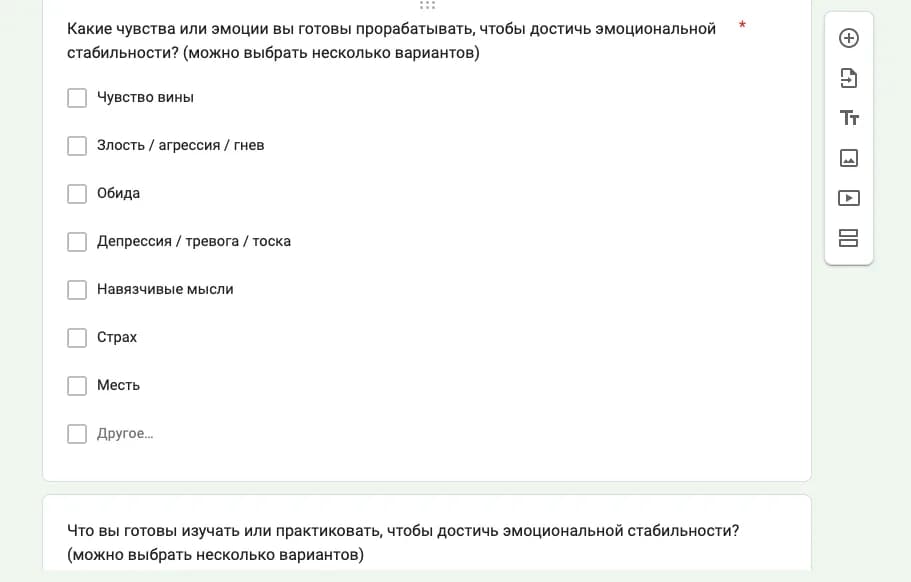
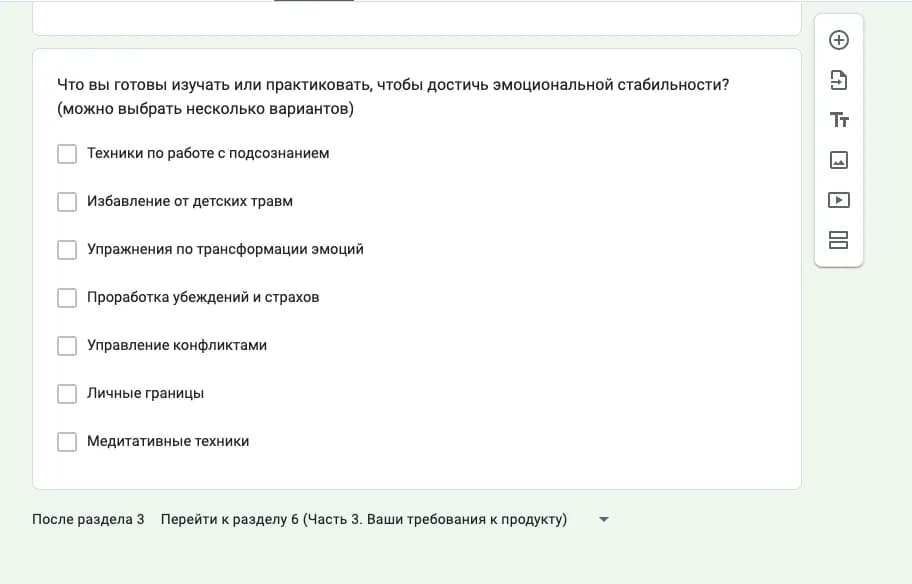
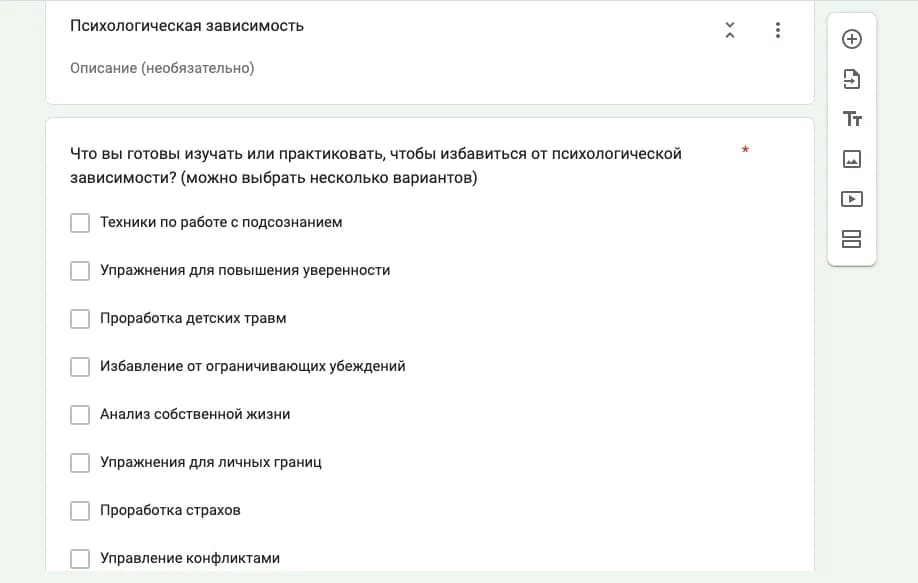
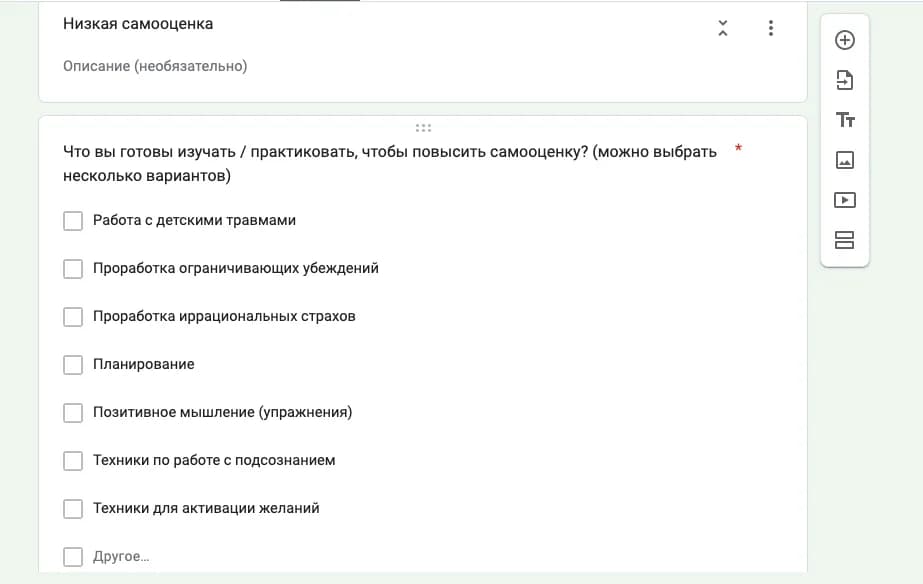
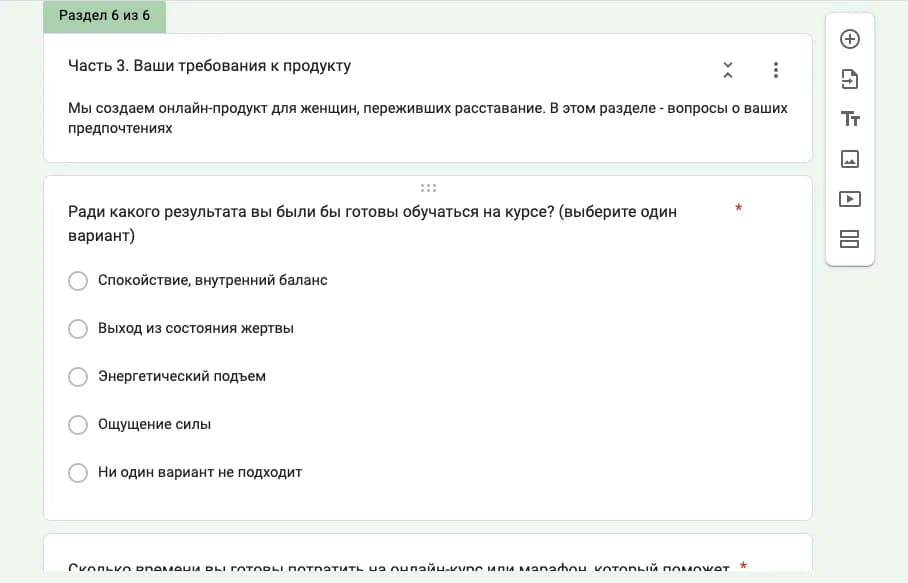
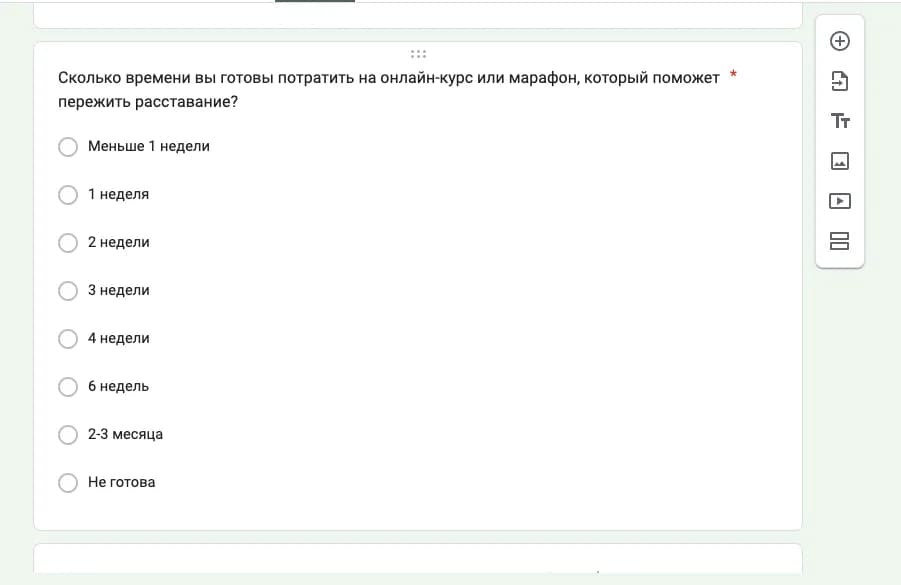
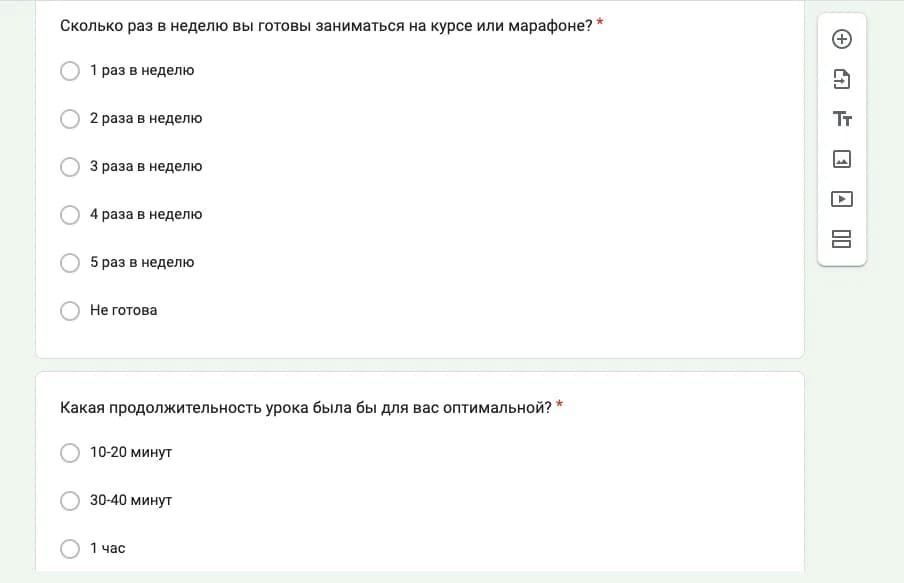
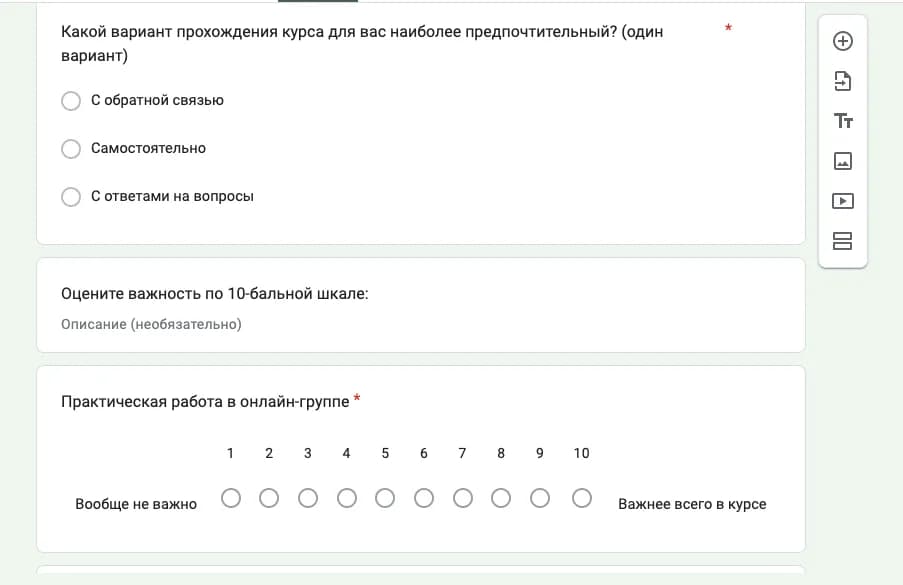
Based on the overlaps we'd collected, we put together questionnaires, one for each segment. The goal was to confirm the problems and phrasing we'd found, and to understand common requests and behavior patterns in the search for a solution.
An additional goal was to find the format most in demand for the online course.
We sent the questionnaire to subscribers and got 148 responses.
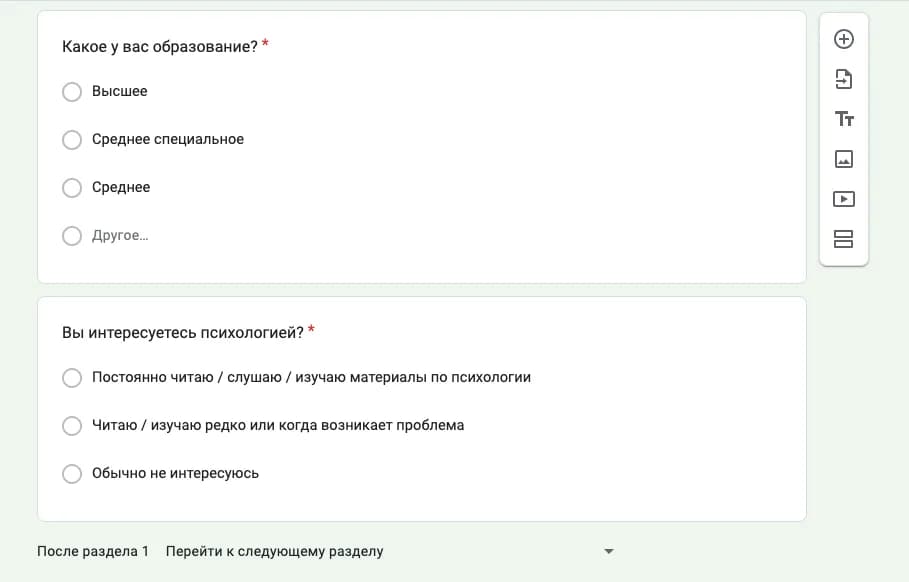
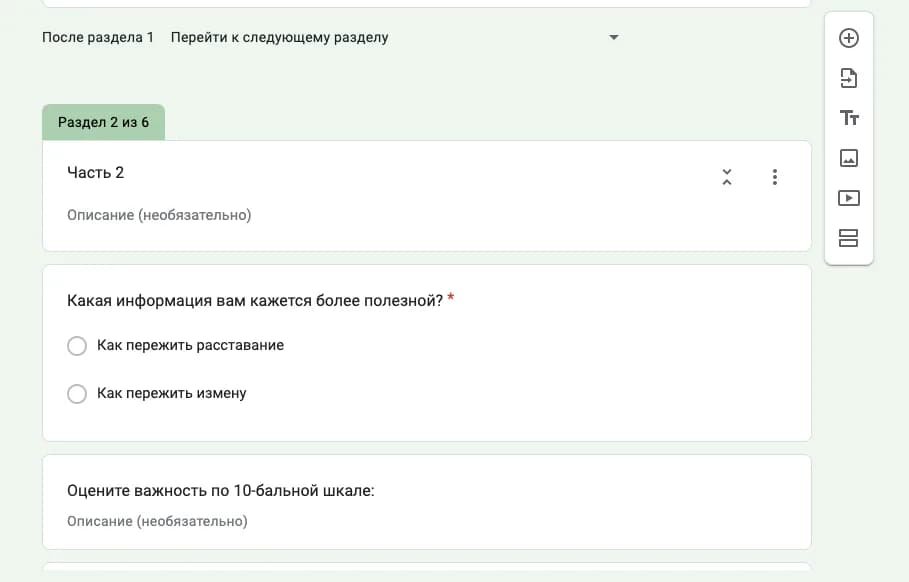
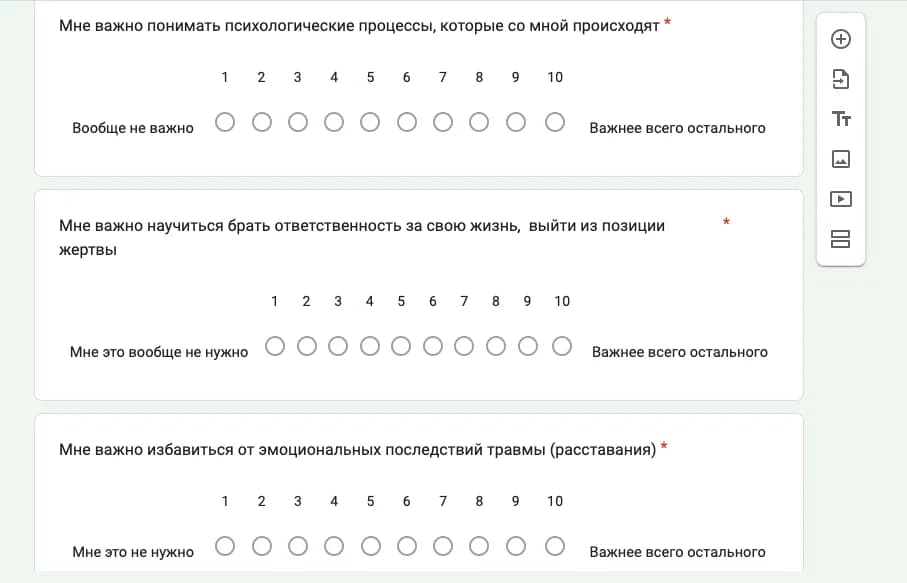
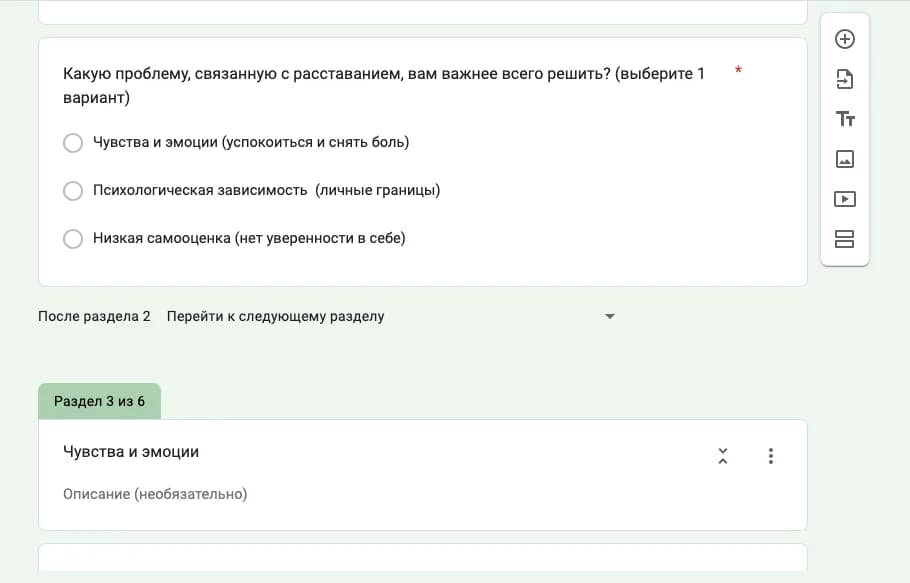
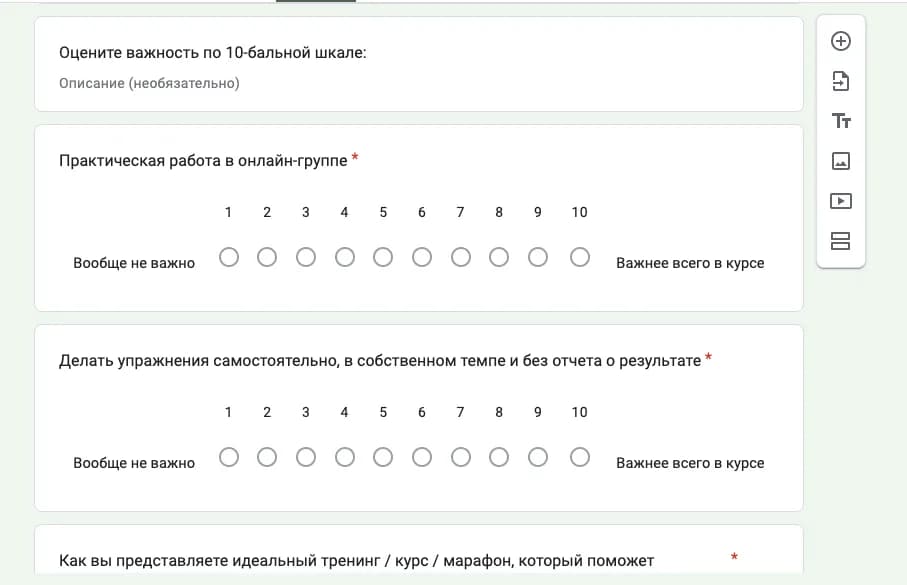
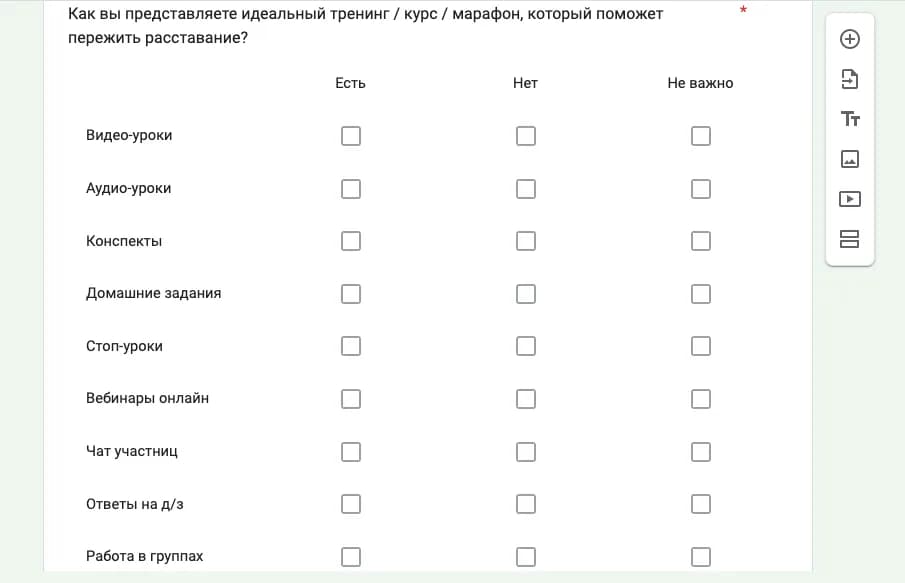
Section 1: education and interest in psychology
The questionnaire isn't linear — it branches depending on the option the respondent picks.
Why did we need a survey at all, if we already knew what words the audience used and how they phrased their goals and problems?
A lot of people stop at this point, but not us. We built the questionnaire to get quantitative confirmation of our findings:
- response to the problem description
- the desired result
- trends in user behavior
Next we sent it out to the whole database, inviting people to take the survey for a nice bonus.
Stage 4. Processing the results
Dashboards with the survey results, a framework for the product.
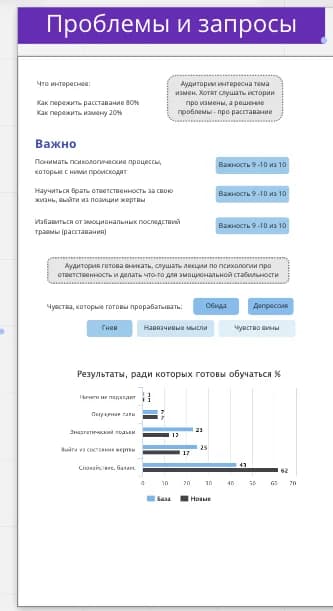
The last and most important part of a custdev is summing up and drawing conclusions. For convenience, we pulled all the information together into a dashboard.
There's no set format for building a dashboard. The only requirement is to lay out all the information clearly and as understandably as possible, group it into meaningful clusters, and draw conclusions.
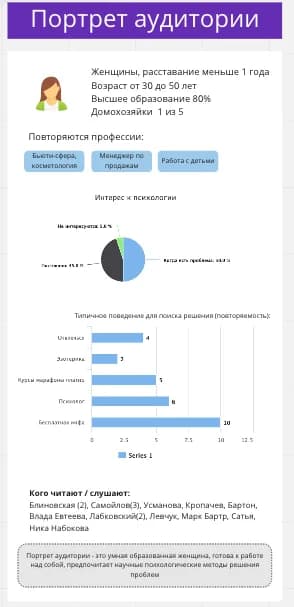
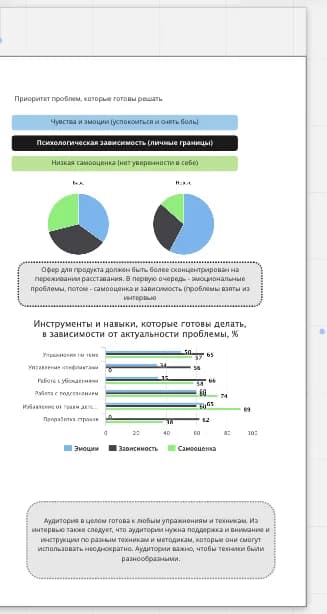
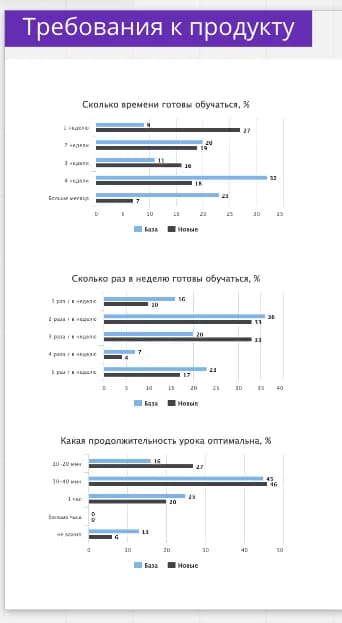
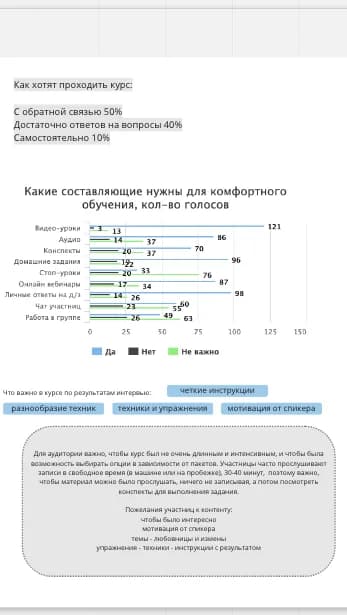
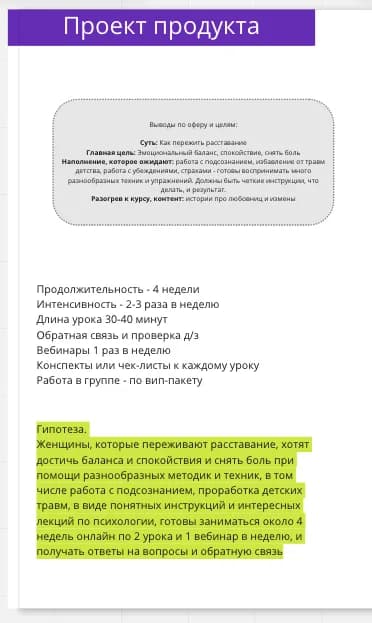
Audience persona: age, education, professions, who they read
You can view the full dashboard with all the conclusions — view it in Miro
And the final task, the one the whole study was for — building the product framework.
A framework is a map of meanings, a field of information you can use to think through the product and search for solutions. The framework lays the foundation for the future product, and the product itself can include various forms of communication: lessons, discussion, games, group interaction, practical exercises, and so on. From there the framework goes to the author, who works with the methodologist to build out the online product.
A product framework built from custdev results makes the product more stable and gives it a foundation for further development.
What was in our framework?
Course results. We formulated the desired result in the clearest possible terms for the audience — but not remotely impressive to the author, or to us either, to be honest.
You'll reach emotional balance and calm. That state will be stable. In 4 weeks you'll calm down and stop the pain, then get past the psychological dependency and raise your self-esteem. Plus 5 additional results.
We also determined how women were willing to get to that result: they wanted to work with the subconscious, with childhood trauma, and were ready to listen to engaging lectures on psychology and follow clear instructions.
We identified a whole list of important requirements for the course and its format. For instance, we discovered a quirk: participants liked to listen to lectures while jogging or driving. That called for 30–40 minute audio lessons, with no interactivity and no need to take notes. And the practical exercises needed to be in video format, recorded separately.
Results
How the research went and how it changed the project.
What important information did we get out of the custdev:
An accurate target audience portrait
We found that 80% of subscribers had a higher education, and most were interested in psychology. We were even able to identify which professions and fields of work were typical for the audience. The interviews also revealed the audience's interests, information that will help shape a content strategy for working with the database.
The audience's request
We got a clear phrasing of the end result the audience wanted. On top of that, we ended up with priorities across their requests. Most of the women who'd been through a breakup needed to get rid of the pain and reach calm and harmony.
We also found out which tools for reaching their goals seemed most suitable to the audience: working through childhood trauma, working with the subconscious, and working with beliefs.
Product requirements
We found out important things about the product's format: it needed engaging lectures, practical techniques and exercises. It needed motivating involvement from the author. Group work was also an acceptable option.
And one more important fact — the sheer amount of free information participants were used to. That means the product needs to start building long before the sale.
Conclusions: how to use custdev to build an online school product
The custdev method gives you a huge amount of information for a project. After a custdev like this, you can start building product experiments: create a version of the product and launch it for sale, testing how well it matches market demand.
Here it's important to understand which results get used unchanged going forward — everything related to the audience's own phrasing and expectations — and which ones remain hypotheses, still to be tested in practice.
For example, we used the following result phrasing in the course packaging and in the webinars: reach balance and calm, get rid of the emotional rollercoaster, get rid of intrusive thoughts. That is exactly what people told us in the interviews, and we confirmed it in the surveys as the most important result.
As for the part relating to the course format (30-minute video lessons, a 4-week duration), we took that into account for the experiment, but it isn't a mandatory condition.
We also took the first result from the list (relieve the pain) for the tripwire.
In the end, we built a product line with sequential results and formats that best suited the target audience.
And of course, extremely valuable information for the expert is learning the audience's specific request — understanding what they think about, what they want, what result they're aiming for, and how they plan to reach it with our product. In JTBD terms — what job the product can be hired to do.
Frequently asked questions

Want to discuss your project?
Something interesting might come out of it
George Ryzhenko
CEO, Digital Experts
More case studies
Real projects with real numbers — what worked, what did not, and why.