

A Cosmetology School in New York: $73,000 in Revenue on $6,000 of Ads
In nine months marketing brought a dead business back to life: 618 leads, $72,995 in revenue on $5,976 of ads — ROMI 1,121%. Full groups on $1,800 and $6,800 courses, $14–50 per sale





What the project came with
Galina Poltoratsky teaches estheticians in Brooklyn — offline, hands-on, in small groups, in Russian. The school has been running since 2021 on her personal brand and her own programs.
The product is expensive: the foundation course for beginners is $6,800, three-day intensives with guest instructors are $1,800, two-day courses are around $600. Students come from Queens, Staten Island, New Jersey and Long Island, and fly in from Florida.
The school took off during covid. Everyone was at home, everyone was studying, demand for training shot up — and Galina rode that wave well: courses ran almost every week. Then the wave passed. Sales crept down, the team drifted away — the marketer changed fields, the SMM manager left after him. By autumn 2025 the project had stalled.
October, November, December — I'm not even planning anything anymore, because there's so much work on documentation, on accreditation… I physically can't keep up, because there's no team, I'm alone.
There was no marketing at all. The request they came with is the one marketers hear most often: make a miracle happen.
What came out of it
The working model — an outsourced marketing department. We built the school a steady flow. We learned how to bring people to every single event. The school runs about 5 events a month, and they never repeat. We learned how to fill all of them. That is what systematic work does.
$72,995 in documented revenue on $5,976 of ads for February–August — ROMI 1,121%. And the most telling comparison is the same course by the same instructor: a year earlier two people signed up, this year — eight, a full group.
The three-day $1,800 intensive: we spent $401, got 101 leads and eight payments — the group filled up completely, the classroom cannot hold more. One sale cost $50 — 3% of the course price. In our experience, 15–20% is considered normal at this price point.
The cost per lead nearly halved: $11.08 in February, $6.48 in July. All of it within the budget agreed at the start: $800–1,000 a month.
The deal
| Advanced Cosmetology Academy, December 2025 — August 2026 | |
|---|---|
| Came with | An offline school in Brooklyn after the covid slump: the team gone, no students, no marketing |
| Bought | An outsourced marketing department: content, ads, automation, analytics |
| Promised | Sustainable marketing that brings warm leads and prepares the audience to buy |
| Not promised | Sales: they stayed with the school, as written into the project goal at the start |
| Got | $72,995 in revenue on $5,976 of ads, 618 leads, full groups on the $1,800 and $6,800 courses |
| Status | Project completed in August 2026 |
How the project went
Three calls. On the very first one we built the school's financial model live: how many sales it needs, what a lead would cost, what is left for the owner. We locked in success metrics for 6 and for 12–18 months.
Competitors, beauty-school case studies, the audience's own words, segmentation, ten hypotheses in Job Statement format. Several hours of interviews with the expert plus her voice notes — all transcribed and assembled into a knowledge base.
Six channels connected, auto-posting and automatic analytics collection set up. In February we switched on ads and fixed the routine: announcement a month ahead, warm-up three weeks ahead, lead generation two weeks ahead.
Ads tied to the school's event calendar, each event gets a 'warm-up + lead-gen' pair. A chatbot on the front line takes in leads, qualifies them and walks them to sign-up.
Three enrollments in June: Demidov's full group and two masterclasses of six people each. Cost per sale — from $14 to $50 on products priced from $100 to $1,800.
The goal we set at the start
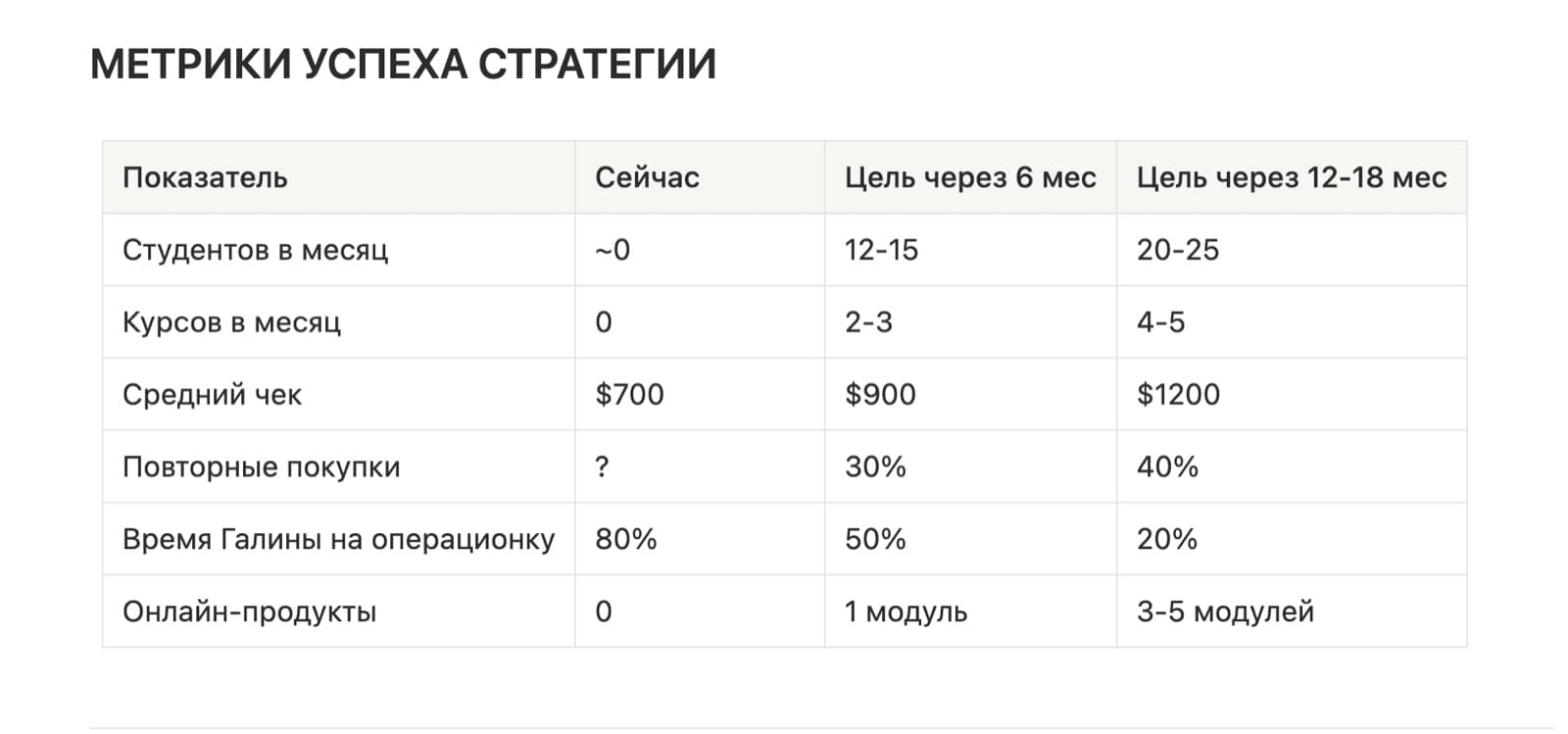
The first thing we did was the school's economics. We sat down and laid it out: an average check of $700, two courses a month needed, that is twelve people, at her own 15% conversion that means about eighty leads, at roughly six dollars a lead — around $550 on ads.
Then rent, an assistant, supplies, an accountant. About $2,790 was left — a 33% margin. We ran it through our financial model — it lays out revenue, costs and the break-even point month by month, three years ahead.
On those numbers we fixed the goal — concrete metrics with a horizon:
The wording of the goal itself, agreed before work began:
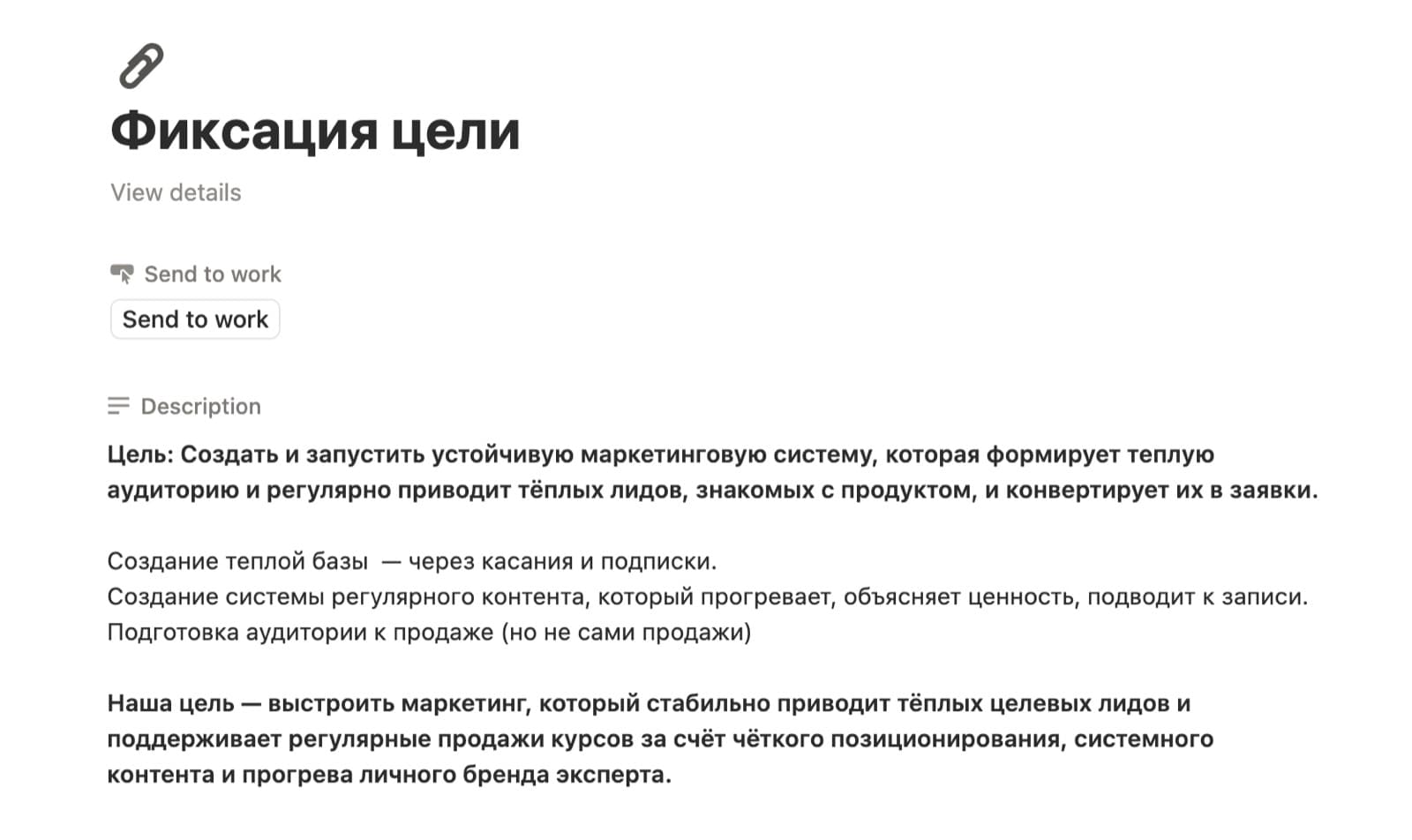
The last line — "preparing the audience for the sale (but not the sale itself)" — is the boundary of responsibility, written down before the start. It will matter later.
Did we hit the goals? Suspense!
Yes, we did. And overdelivered. And went past the boldest wishes. In this case we turned out to be real magicians — as ordered.
The sixth month of work was June, so that is the month we check against.
Students per month — wanted 12–15, we delivered more than 20.
Courses per month — wanted 2–3, delivered 5 on average.
Average check — wanted $900, delivered $2,212 — based on confirmed enrollments.
Research and knowledge base
The first month went into understanding the market and pulling out of the expert what had been sitting in her head for twenty years.
We did a competitor study — who else trains estheticians in New York, on what programs and for how much. We collected beauty-school case studies from other markets — what works there and what could be tried here. We went through forums and communities and gathered the audience's own words: how people themselves describe why they go for further training.
From that material we ran an audience segmentation — five core segments and seven additional ones, each with its own funnel. And we built product hypotheses in JTBD form: "when I've got my license but almost no clients, I want to learn to understand skin so I stop feeling like an impostor."
From then on we worked from the hypotheses — content topics came from what the audience genuinely cares about.
The entire audience, unexpectedly, is Russian-speaking. These are beauty professionals from New York and neighboring states who study in Russian. Narrow by definition — you would not expect a New York school to be limited to one language, but there it is…
In parallel we assembled the project's knowledge base. Several hours of interviews with Galina, and we took the whole thing: a base of her style — the way she talks; a base of knowledge about the company and the product; an understanding of the audience. Plus we gave her topics to talk through as voice messages to a bot — those were transcribed and organized too.
That made it possible to switch on automation. An important point: we do not pump AI-generated content into accounts. It does not work.
Automation produces the draft only. To build it, the model is given the project's entire context:
- product description
- the current task
- the market situation
- the hypothesis the piece is made for
- metrics of previous hypotheses
- the expert's knowledge base
- her style base
Such a draft is expensive in tokens — and very good on the way out, because it is built from the specifics of this project rather than generic phrases.
Then a human editor takes over. All content goes through a human edit. Sadly, that is how it is for now… I'm sure it will change.
Not a single piece of content goes public without a human edit. That is exactly what produces the quality and the audience engagement you can see in the numbers.
The content pipeline
We connected six channels:
- YouTube
- TikTok
- Telegram
- a WordPress website
We set up automations for posting to all six channels and for collecting analytics from each.
The school sees all of it in its own dashboard. The content calendar: what goes out, when, on which channel, and what is already published and running as an ad.
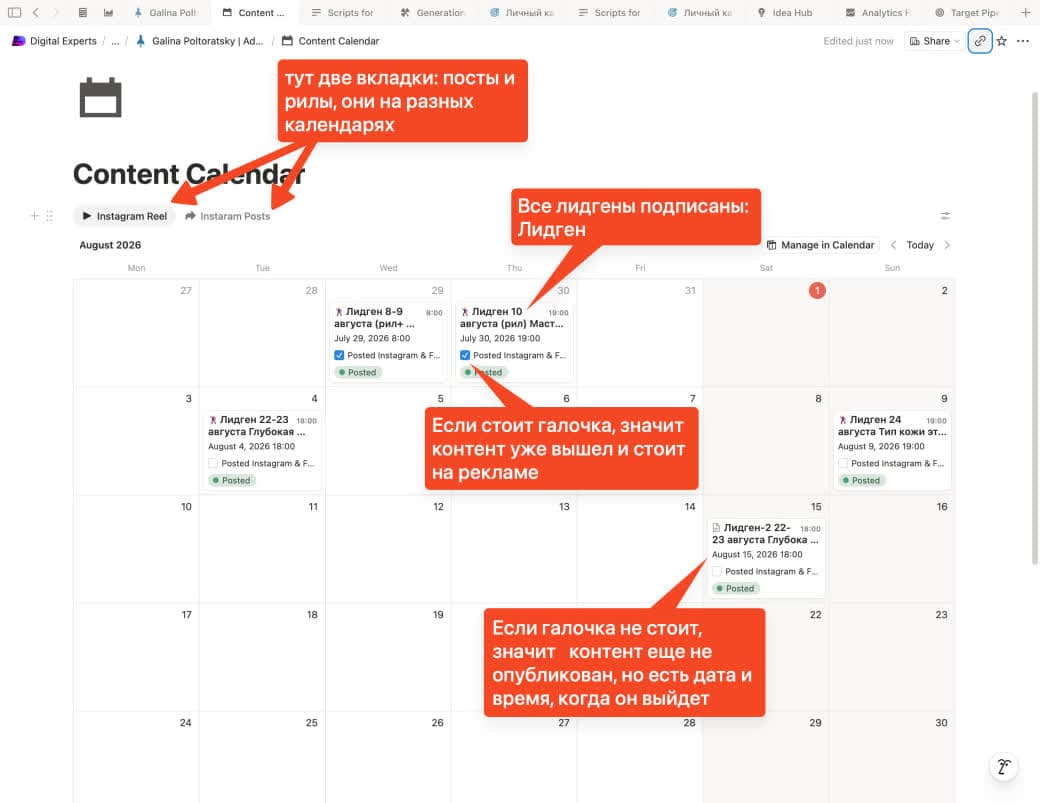
How the video cycle works. For a hypothesis, a segment and a task, a script is written — based on transcripts of the expert's voice messages, that is, in the expert's own language, so reading it is as easy as it gets for her because it is already written in her own words. We batch scripts for a single shooting day, the expert sits down and records everything at once… in theory.
In nine months Galina recorded ONE expert video. Everything else she gave us was footage from events and photos. THAT'S ALL! But we made soup from a stone ;) we're professionals after all!
We assembled the videos ourselves: voice-over plus footage from Galina's studio. And the warm-up content we made as carousels.


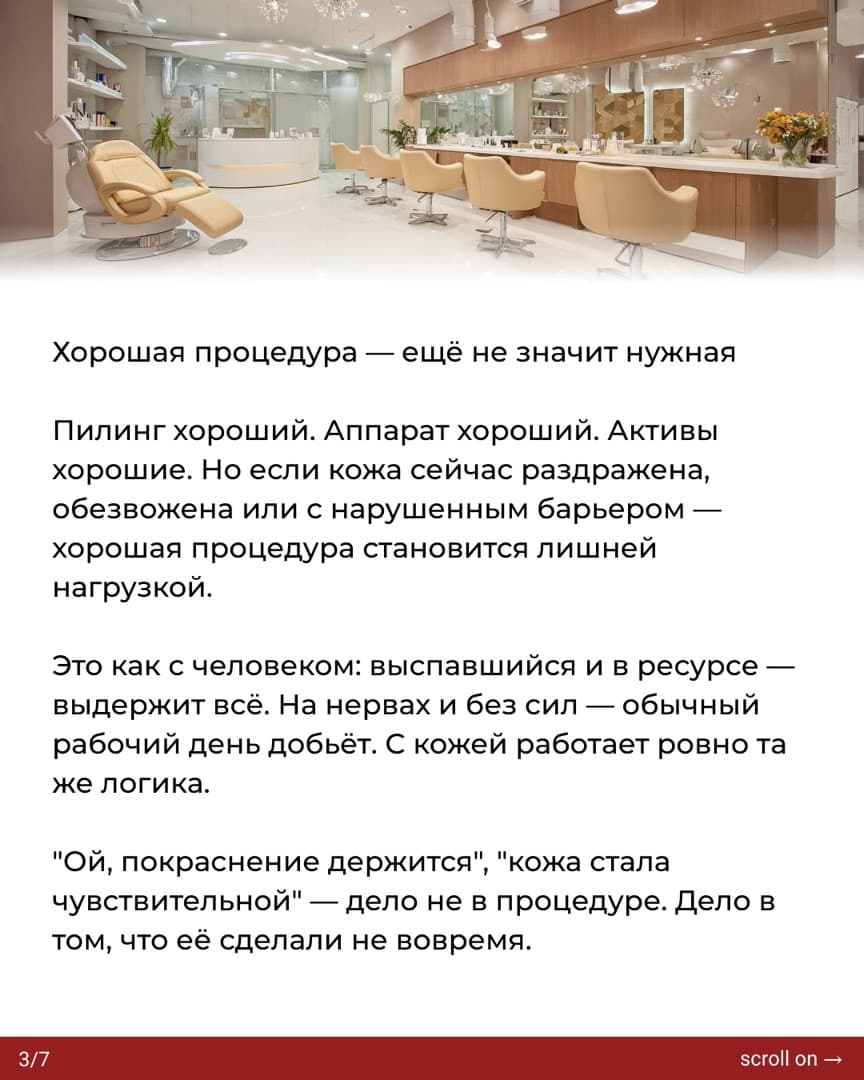
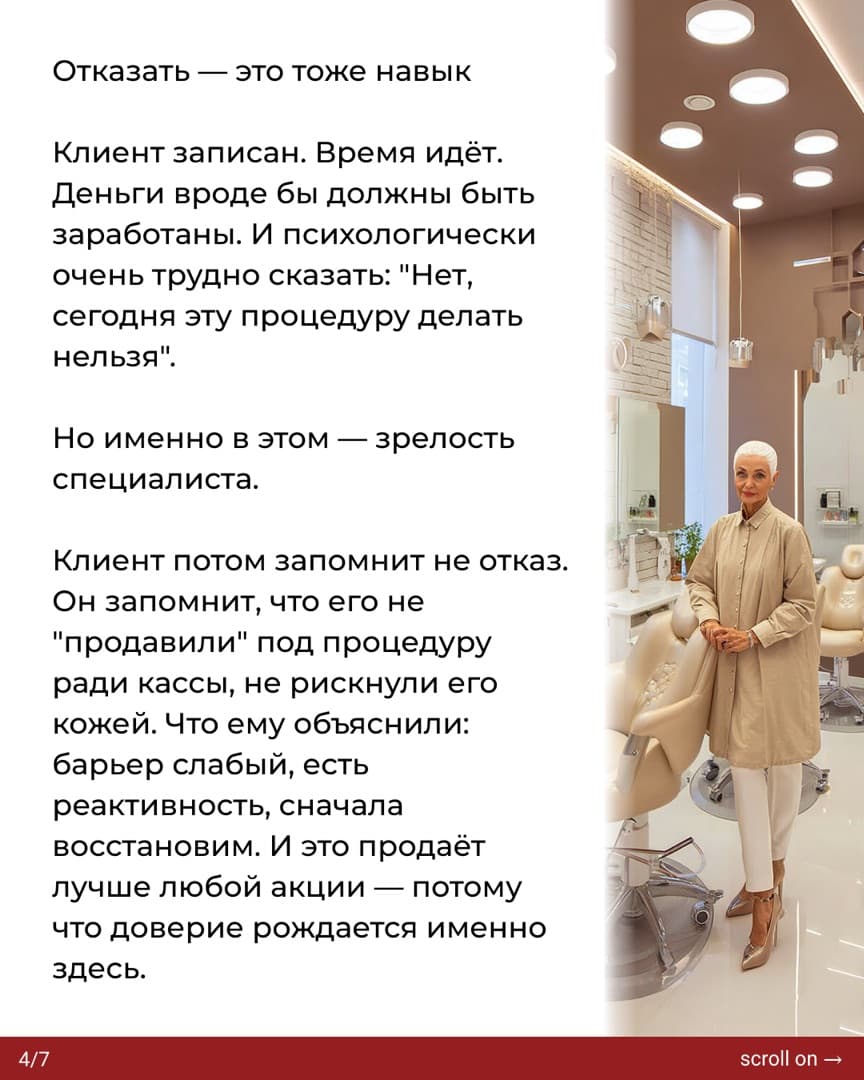
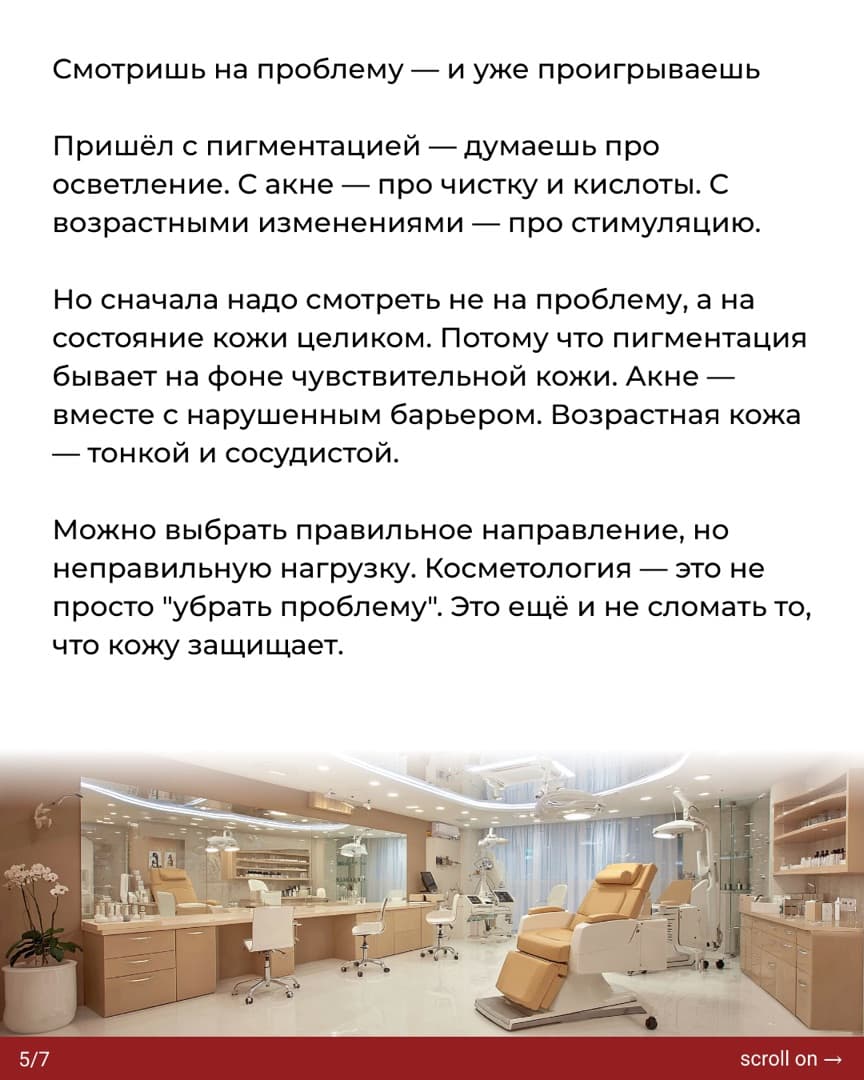


Slide 1 — the hook
Here is one such carousel in full — "Not every skin should be touched right away." Its job is to get a person reading for pennies: CTR 6.2% against the project average of 2.65%, a click at $0.20 against the average of $0.81.
Reel covers were made the same way — for the topic and for the segment's pain:








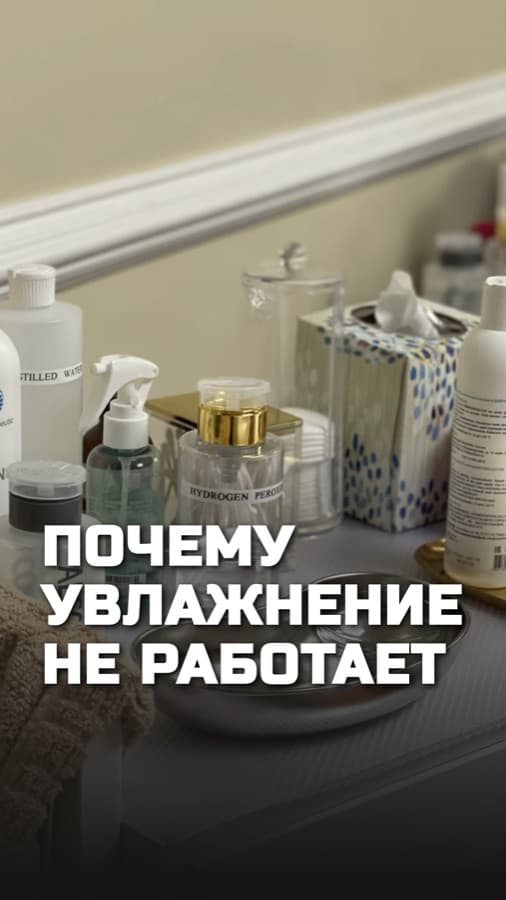



'An esthetician must think'
Engagement: seven times the norm
This is exactly why we bother with our pipelines, research and analytics — seven times the market, folks! Here are the numbers by campaign:
| Campaign | Reach | Reactions | Saves | Comments | Engagement | vs. norm |
|---|---|---|---|---|---|---|
| Microneedling | 5,751 | 43 | 4 | 1 | 40.7% | ×7.4 |
| Facial massage | 8,040 | 63 | 15 | 5 | 40.6% | ×7.3 |
| Myolifting massage, Denis Demidov | 5,669 | 69 | 12 | 2 | 39.2% | ×7.1 |
| Rosacea | 2,339 | 24 | 2 | 1 | 37.9% | ×6.9 |
| Retinoic peel | 2,849 | 15 | 0 | 2 | 35.2% | ×6.4 |
| Facial massage, video | 5,284 | 37 | 4 | 3 | 34.2% | ×6.2 |
| Secret code of the skin | 1,589 | 17 | 2 | 0 | 31.7% | ×5.7 |
| Acne | 2,440 | 11 | 2 | 0 | 24.0% | ×4.3 |
These are not lucky flukes on two hundred impressions. These are campaigns reaching one and a half to eight thousand people, and on the best ones four out of every ten people who saw them reacted in some way: watched the reel to the end, clicked, reacted, saved it. Even the weakest row in the table is four times the norm.
Saves deserve a separate look. Up to fifteen saves per campaign in a narrow professional niche — that is fifteen estheticians who put the post aside to come back to it. That is how people treat useful material, not ads.
These are not eight good campaigns out of a hundred. The end-to-end quality score the system computes for every piece — an average Content Quality Score of 164 against a market norm of 100 across all 133 campaigns of the project. Above the norm — 89 campaigns out of 133.
A Content Quality Score of 164 means the content beat the average engagement benchmarks by 64%. And that is impressive — because a lot of test content never even reaches 100; it gets weeded out, but it still drags the average: 44 campaigns out of 133 came in below the norm with an average of 75. The good content, meanwhile, scores 300–500 on average — three to five times better than the industry.
Engagement of up to 40% on the best campaigns against a 5.5% norm means one simple thing: the audience did not perceive this as advertising.
Analytics for every piece of content
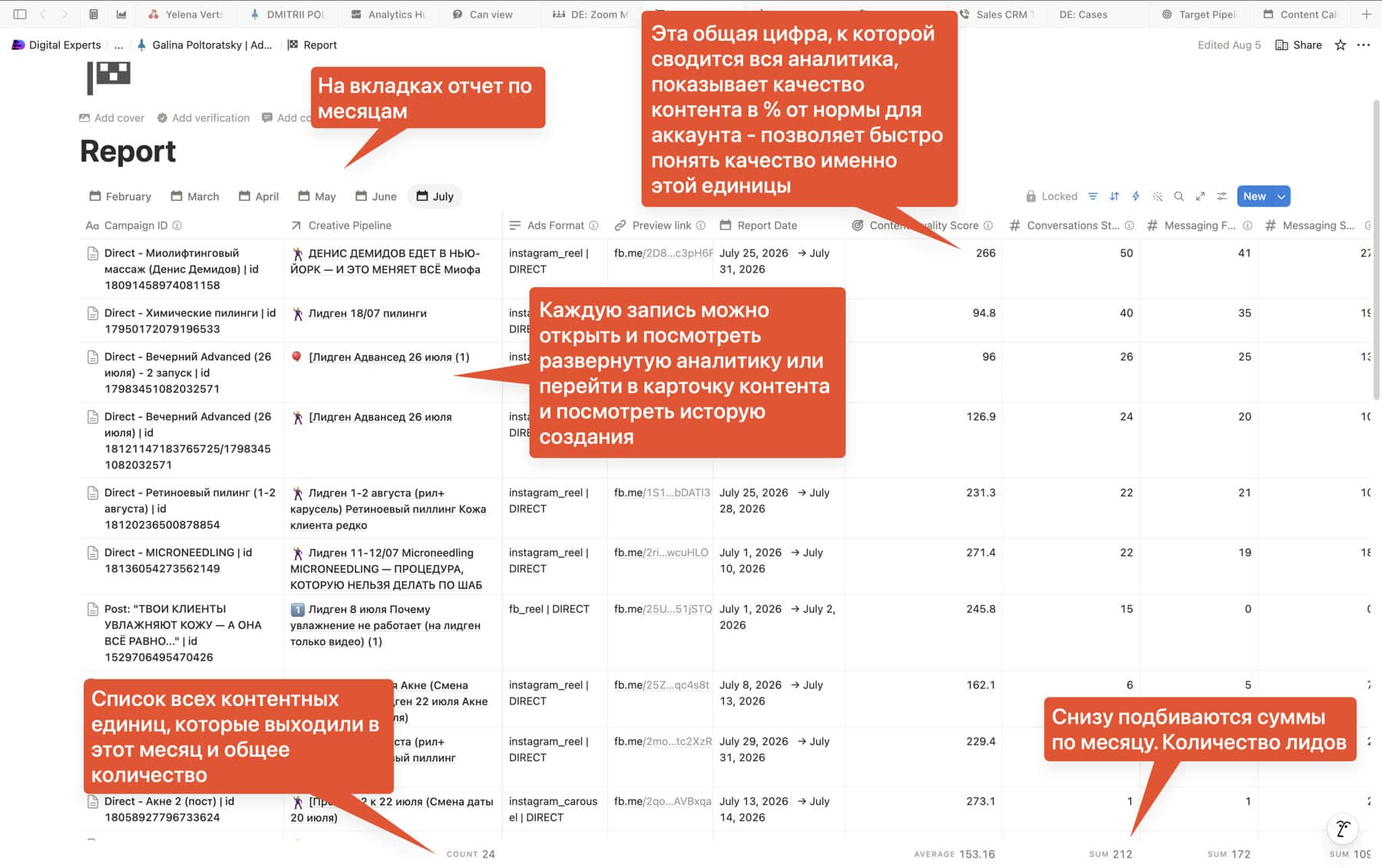
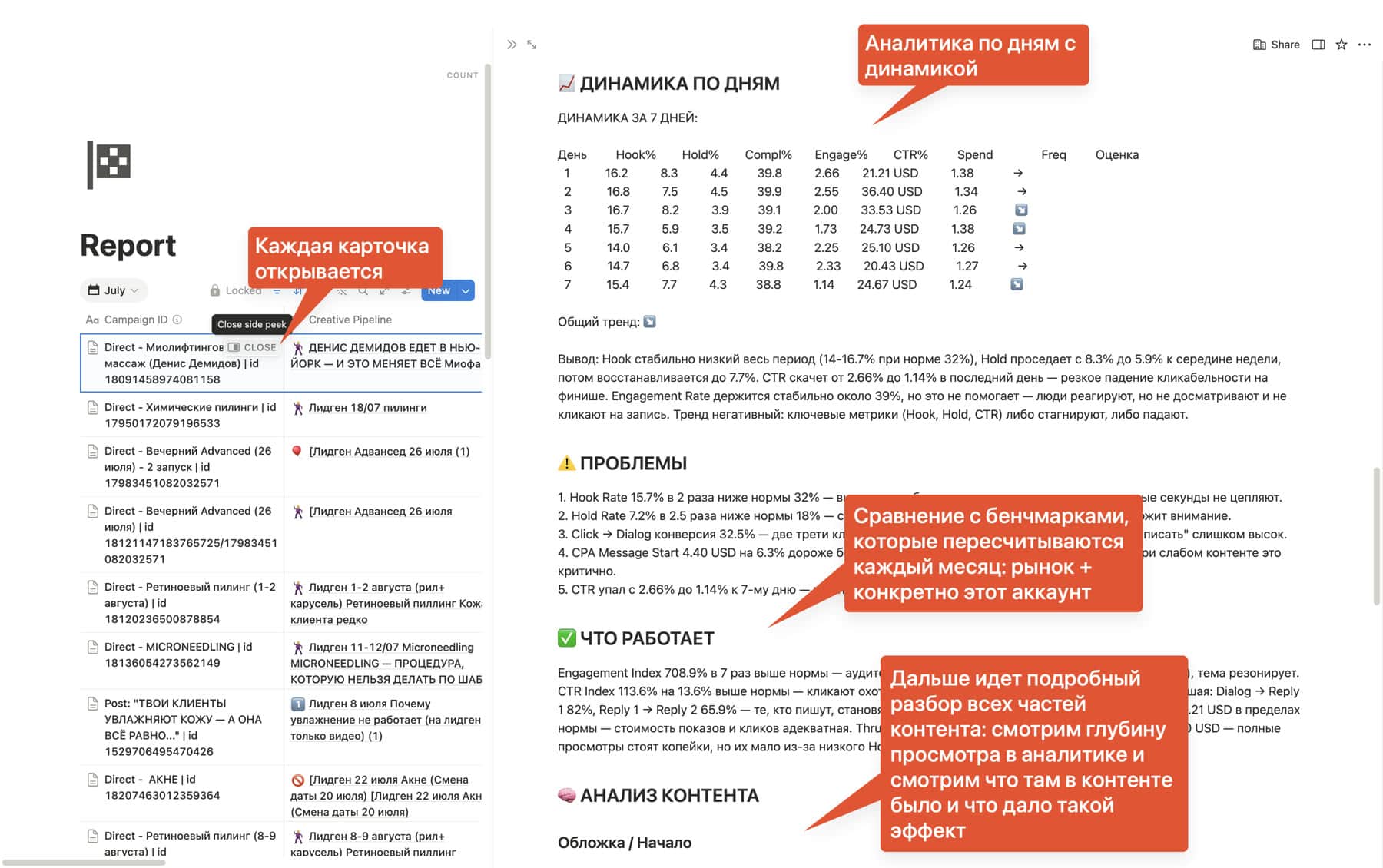
Monthly report: every row is a piece of content, with its quality score and message funnel on the right
Analytics are collected automatically for every publication and every campaign — every day, rolling, seven days deep. The full set of metrics from Facebook, about 100 different numbers. The metrics are matched to the text of the video or carousel, so we can see which part of the content did what. That allows a very deep breakdown.
And of course a neural network with recommendations, how could we do without one, suggests what to do with the content: leave it as is, scale it, or stop it — and why.
Here is one such breakdown in full, without cuts. The "FACIAL MASSAGE" campaign — a reel that in May drove enrollment for the June $1,800 intensive, the very one that later filled up completely.
Continue. The campaign has been running steadily for 16 days, the cost per conversation of $5.17 fits the economics, the message funnel shows a high Reply 1 → Reply 2 conversion (89.8%), but the CTR Index is below the DIRECT norm — 86.6% against an 85% threshold. Frequency of 1.24 is normal, the audience is not burning out. The content hooks weakly (Hook 13.9%), but those who start writing engage actively. We keep collecting conversations and in parallel test a more aggressive hook in the first three seconds: the current script does not stop the scroll hard enough.
| Field | Value |
|---|---|
| Name | Direct — FACIAL MASSAGE |
| Format | Instagram Reel, direct ad |
| Primary CTA | 'DM us or call' — goal: send a direct message |
| Secondary CTA | Call |
| Run period | May 15–31, 2026, 16 days |
| Budget | Value | |
|---|---|---|
| Spent | $233.31 | |
| CPM | $23.31 | ✅ |
| CPC | $1.43 | ✅ |
| Cost per conversation started | $5.17 | 🟡 |
| Cost per first reply | $5.74 | ✅ |
| Cost per second reply | $5.28 | ✅ |
| Cost per third reply | $8.39 | ✅ |
| Reach and content | Value | |
|---|---|---|
| Impressions / reach | 10,008 / 8,040 | |
| Frequency | 1.24 | ✅ |
| Content Quality Score | 271.6% | ✅ |
| Hook Index | 43.4% | ❌ |
| Hold Index | 37.2% | ❌ |
| Completion Index | 30.8% | ❌ |
| Engagement Index | 734.2% | ✅ |
| CTR Index | 86.6% | 🟡 |
| Cost checks | Value | |
|---|---|---|
| CPC within budget | yes | ✅ |
| CPM overspend | 0.0% | ✅ |
| CPC overspend | 0.0% | ✅ |
| Frequency warning | no | ✅ |
| Overspend on cost per conversation started | 124.9% | ❌ |
| Message funnel | Conversion | What it means |
|---|---|---|
| Click → conversation | 35.0% | every third click starts a conversation — normal for a cold audience |
| Conversation → reply 1 | 86.0% | almost all conversations get a first reply |
| Reply 1 → reply 2 | 89.8% | very high engagement after the first contact |
| Reply 2 → reply 3 | 63.6% | two thirds move into a deep conversation |
Interpretation. The content hooks poorly at the start (Hook 43.4% of the norm), but those who start a conversation engage actively. CTR is on the edge of acceptable for DIRECT. The cost per conversation started is 124.9% above the benchmark, but funnel depth compensates: a third reply costs $8.39 against a $50 benchmark. That points to a quality audience and good work in the DMs.
| Day | Hook % | Hold % | Compl % | Engage % | CTR % | Spend | Freq | |
|---|---|---|---|---|---|---|---|---|
| 1 | 14.8 | 7.5 | 5.0 | 40.8 | 2.97 | $17.56 | 1.36 | → |
| 2 | 17.1 | 7.4 | 4.4 | 44.3 | 2.33 | $8.87 | 1.18 | → |
| 3 | 15.5 | 6.0 | 3.2 | 45.4 | 1.97 | $18.45 | 1.27 | ↘ |
| 4 | 14.7 | 7.3 | 3.1 | 42.2 | 2.36 | $16.23 | 1.30 | → |
| 5 | 15.0 | 7.8 | 4.8 | 42.2 | 1.19 | $14.55 | 1.23 | → |
| 6 | 15.4 | 8.1 | 5.2 | 42.9 | 0.94 | $16.01 | 1.25 | ↗ |
| 7 | 13.9 | 7.1 | 4.1 | 40.7 | 1.95 | $13.85 | 1.23 | ↘ |
| 8 | 12.0 | 5.9 | 3.7 | 37.2 | 1.01 | $11.97 | 1.25 | ↘ |
| 9 | 13.4 | 7.2 | 3.3 | 42.9 | 1.44 | $13.45 | 1.16 | ↗ |
| 10 | 13.4 | 6.7 | 3.9 | 39.6 | 1.69 | $15.94 | 1.29 | → |
| 11 | 14.0 | 6.4 | 3.4 | 39.7 | 1.22 | $19.28 | 1.24 | ↘ |
| 12 | 13.7 | 5.6 | 2.6 | 39.2 | 1.06 | $15.72 | 1.20 | ↘ |
| 13 | 10.8 | 5.3 | 3.0 | 35.3 | 1.03 | $15.33 | 1.23 | ↘ |
| 14 | 12.6 | 6.5 | 3.5 | 36.0 | 1.14 | $15.28 | 1.24 | → |
| 15 | 10.8 | 5.0 | 4.2 | 37.7 | 2.31 | $2.95 | 1.07 | → |
| 16 | 11.7 | 5.3 | 2.7 | 39.8 | 1.80 | $17.87 | 1.26 | → |
Overall trend: → Over 16 days the campaign shows stable but modest content metrics. Hook fluctuates between 10.8 and 17.1%, averaging 13.9% — that is 43.4% of the 32% benchmark. Hold and Completion are weak too. Frequency stays within 1.16–1.36: the audience is not burning out.
- Hook Rate 13.9% — critically weak for a direct ad against a 32% norm. The first three to five seconds do not stop the scroll: the "Face lifting without needles" cover creates neither urgency nor drama. 86% of the audience scrolls past immediately.
- CTR Index 86.6% — at the lower edge for DIRECT against an 85% threshold. When people click, 35% start a conversation, but the click itself is rare. A clearer "why now" trigger is needed.
- Cost per conversation started $5.17 against a $4.14 benchmark — 124.9% overspend. Starting a conversation is expensive, though the funnel works excellently after that. The problem is at the top, not in audience quality.
- Hold 6.7% and Completion 3.7% — 93% of the audience drops off after the hook. The content does not develop intrigue; there is no build-up of tension and no visual proof of results.
- Engagement Index 734.2% — seven times the DIRECT norm. 63 reactions, 15 saves, 5 comments even with a weak hook. Estheticians are saving the post for themselves — which means it hit a real pain.
- The message funnel runs like clockwork: conversation → reply 1 = 86%, reply 1 → reply 2 = 89.8%, reply 2 → reply 3 = 63.6%. Those who reach a conversation become hot leads; the third reply costs $8.39 against a $50 benchmark.
- Frequency 1.24 against a 2.8 ceiling — the audience is fresh, the ad can run for a long time without burnout.
- CPM $23.31 and CPC $1.43 within budget — the targeting works, the platform is not inflating rates.
Cover. The headline "Face lifting without needles" is clear but without drama: to a skeptical esthetician it looks like yet another miracle product. No specifics and no visual before-and-after demonstration. The impulse "I want to know more right now" is not created.
| Point | Watched to | Verdict |
|---|---|---|
| Hook, ~15 sec | 13.9% | ❌ 86% scroll past immediately. The first line needs a provocation or a pain |
| Hold, ~30 sec | 6.7% | ❌ No build-up of intrigue, no reason to keep watching |
| Middle, ~45 sec | 4.5% | ❌ No climax and no exclusive insight |
| Ending, ~55 sec | 3.7% | ❌ Those who got here are ready to write, but there are too few of them |
| To the end, 60 sec | 3.3% | ❌ Normal for an ad reel, but the top of the funnel is undercooked |
What happens second by second. There is no text in the script — the hook rests only on the cover and the visuals; no verbal pattern break or question that would make someone stop is built into the reel. Only those interested in facial massage for its own sake make it to the middle: the technique is shown there, but the intrigue does not build, no reason to keep watching appears. The most interested reach the final third — probably those already looking for continuing-education courses. Only a handful reach the call to action: they are ready to write, but there are too few of them.
Meaning triggers. No non-advertising triggers identified — there is no script. The content rests on the "lifting without needles" pain and on the authority of the guest expert. 15 saves show the topic hit a pain, but did not create urgency.
Why it landed:
- Pain. Estheticians are looking for non-invasive techniques for aging clients.
- Status. The expert's name builds trust if he is known in the community.
- Practicality. "90% practice" removes the fear of empty theory.
Final verdict. Content Quality Score 271.6%. The content works by hitting a pain and through a strong message funnel, but the visual delivery is weak: the hook does not stop the scroll, retention does not hold. High engagement compensates for the weak video — people save the post without watching it through. To scale, a new hook with drama or a before-and-after case is needed. The current version is fine for collecting warm leads, but not for aggressive growth.
A caveat for DIRECT campaigns. The 271.6% Content Quality Score here is a reference metric. The "continue" decision was made on the basis of the 86.6% CTR Index (slightly below the norm, but acceptable) and the $5.17 cost per conversation started (124.9% overspend, but justified by funnel depth). The content still needs improving — precisely to bring down the cost per conversation started.
A breakdown like this comes in for every piece: the decision to continue, change or stop is made not by gut feeling but by indices — and not once a month, but daily.
The project average: Content Quality Score 164.5 against a norm of 100, engagement 10.5%, CTR 2.65%, average click $0.81. That is across all 133 campaigns of the monthly report, not a selection.
The full analytics cards can be viewed in their entirety: for the ad post and for the reel.
How these analytics are used
Getting analytics is not enough. They have to be used — and that is something only a few do. Usually a report is compiled, sent out and dies: nobody has the time to look at the whole thing.
We built a system where analytics are not an appendix to the work but part of it. A neural network on the media buyer's pipeline sorts the ad campaign cards into columns according to the recommendation the breakdown produced: what to stop, what to scale, and what can be left alone.
This is the media buyer's pipeline that they work with every day. The system is described in more detail in the article “Automating targeting with AI”.
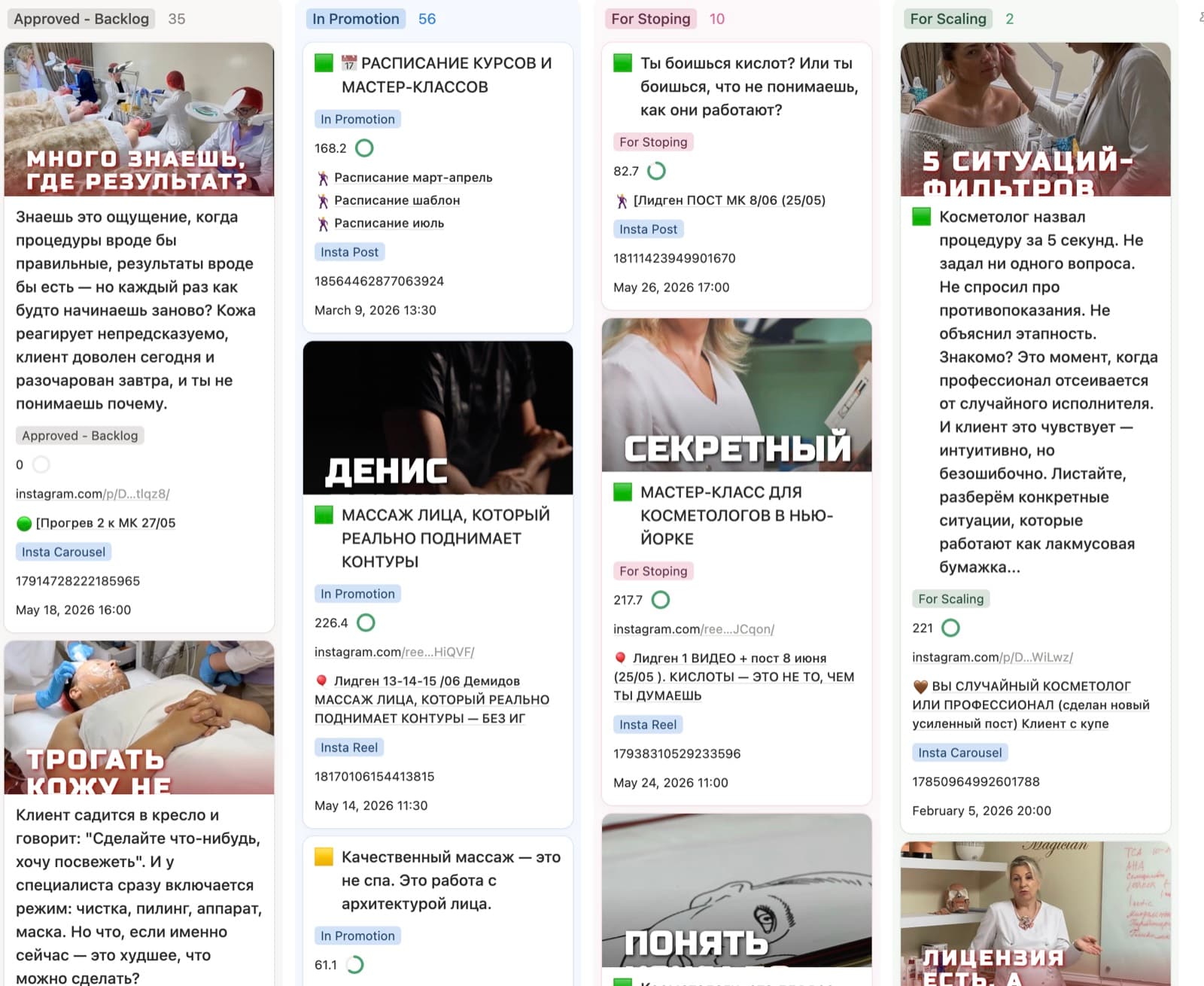
A media buyer is a living person with a limited attention budget. They open the board and immediately see what is proposed for every campaign and why. Not "here are two hundred rows, figure it out," but four columns: what is waiting to launch, what is running, what needs stopping, and what needs scaling.
Attention goes where it is actually needed. That is exactly why the cost per lead in this project nearly halved over six months: decisions were made every day and for every piece, not once a month and by eye.
Advertising the events. The lead-gen pipeline
Every month the school has a new schedule: masterclasses, intensives, courses. Five events on average, almost always new, never repeated. Each one needs its own warm-up and acquisition cycle.
Here is the rough scheme:
The routine, February 17. The school provides the schedule for the year. The announcement of next month's events goes out a month ahead. The warm-up post — three weeks ahead. Two weeks ahead — lead generation.
Budget $800–1,000 a month. Five events on average, $200 each: $50 for the announcement — five days at $10 — and $150 for lead generation. At roughly $5 per lead that is about 30 leads per event.
Here is what six months produced — the final numbers:
| Month | Budget | Leads | Reply 1 | Reply 2 | Reply 3 | Cost per lead | Cost per reply 2 | Cost per reply 3 |
|---|---|---|---|---|---|---|---|---|
| February | $210.60 | 19 | 9 | 8 | 4 | $11.08 | $26.32 | $52.65 |
| March | $853.43 | 103 | 71 | 47 | 36 | $8.29 | $18.16 | $23.71 |
| April | $649.47 | 43 | 14 | 6 | 2 | $15.10 | $108.24 | $324.73 |
| May | $1,231.24 | 147 | 67 | 63 | 41 | $8.38 | $19.54 | $30.03 |
| June | $658.36 | 94 | 48 | 38 | 31 | $7.00 | $17.33 | $21.24 |
| July | $1,373.33 | 212 | 172 | 109 | 72 | $6.48 | $12.60 | $19.07 |
| Total | $4,976.43 | 618 | 381 | 271 | 186 | $8.05 | $18.36 | $26.76 |
How to read this. A lead is someone who tapped the ad and landed in a conversation. Reply 1 — they answered the bot's first message. Reply 2 — the conversation continued. Reply 3 — they got as far as discussing a specific course and date.
The last three columns are the cost of each step, and this is where it gets interesting. A person who reached the third reply cost $26.76. For a product priced at $599–1,800 that means even if one in ten of them buys, the advertising stays profitable by a wide margin. Lead quality kept rising: in July every third lead reached the third reply, and the cost of that step fell to $19.
The same cost per lead as a line. February — $11.08, July — $6.48. The April spike to $15.10 is the month the school was reshuffling the schedule on the fly: one event moved, another cancelled, a third added.
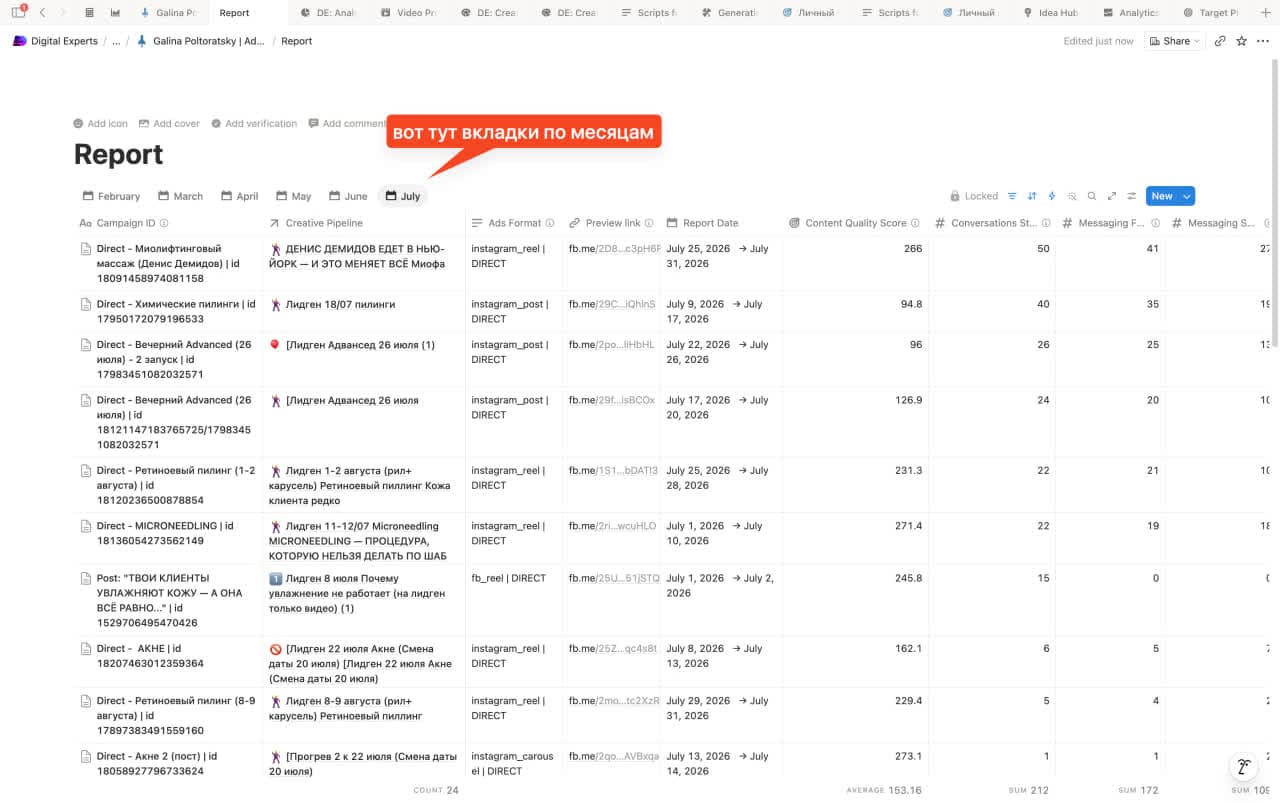
The average budget — $829 a month. Exactly what was agreed. The full report on all 133 campaigns — the same file the client saw.
In the dashboard it sits as monthly tabs: every row is a campaign, next to it the creative, the format, a preview link, the content quality score and the whole message funnel.
This is what it looks like in the ad account itself:
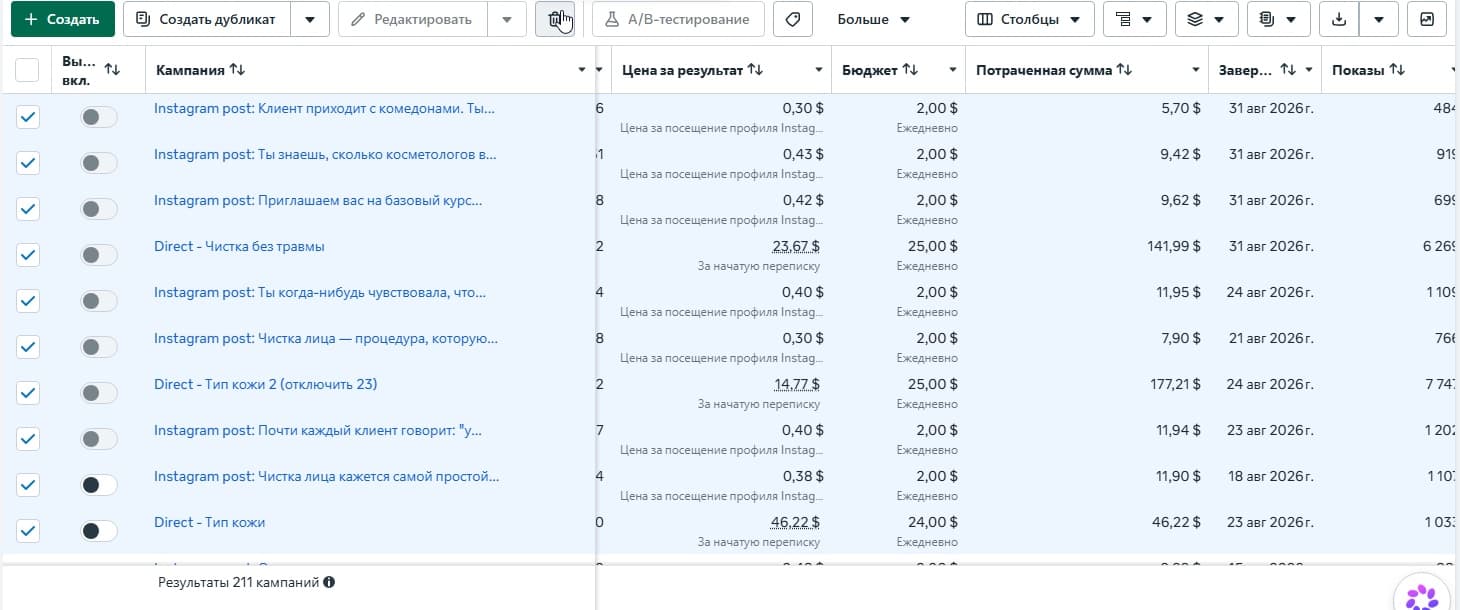
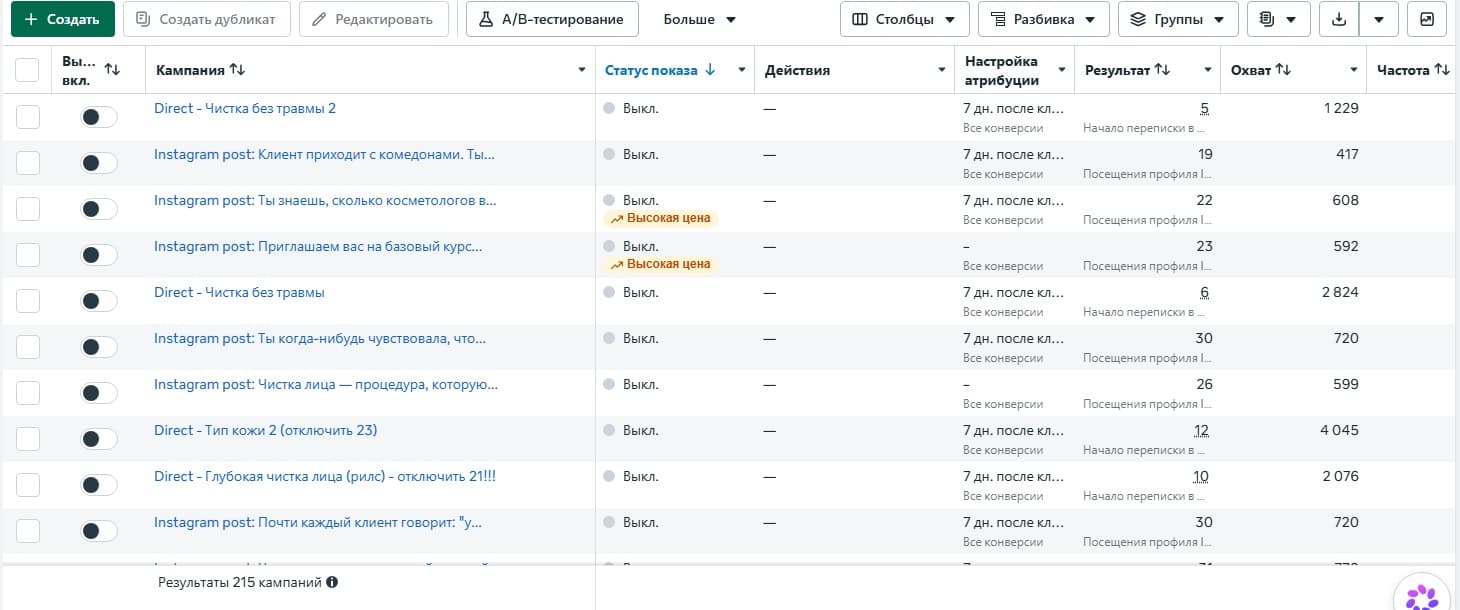
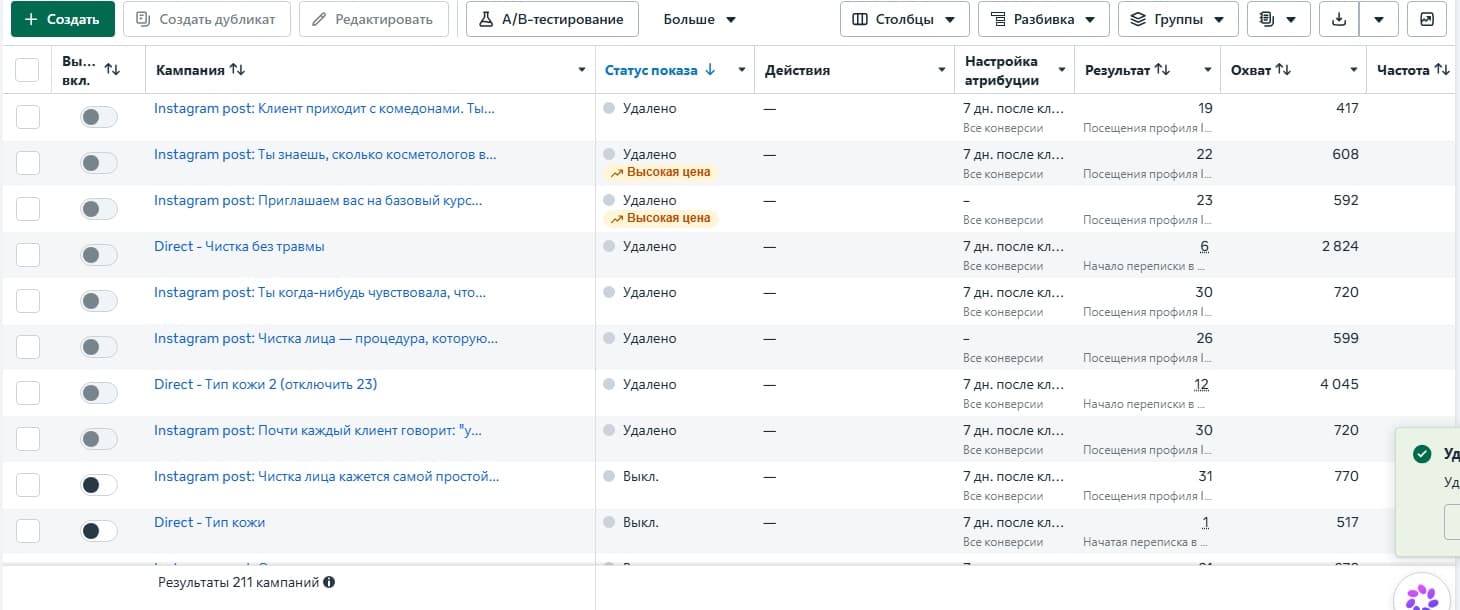
Cost per result, budgets and amounts spent by campaign
Warm-up posts run at 30–43 cents per profile visit on a $2-a-day budget. Lead-gen campaigns — at $14–47 per conversation started, on a $24–25-a-day budget. Different jobs, different prices, and both fit the economics.
Testing the English-speaking market
The school's audience is Russian-speaking beauty professionals from New York and neighboring states, and it is finite. Right next to it lies a market many times larger, so at the start we asked: are you ready to work with English-speaking clients? They said they were. In late February we tested it — the same foundation course, but in English.
Foundation course in English. Leads are cheaper and engagement deeper: first message at $3.5, second at $6.2. Looks like a serious bid for the English-speaking market. We keep it running.
Leads came in cheaper than the Russian-speaking ones, the bot took them in, conversations started — and it became clear the school could not work with them: teaching is in Russian, and nobody could sustain a conversation with an English-speaking client. The market stayed behind glass.
Why this is a crazy race
There is nothing repeatable here. Every month — new events, new topics, new creatives, a new audience for every topic. Nothing can be set up once and left running: five events a month means five announcements, five warm-ups, five lead-gen campaigns and five different streams of leads to process.
And in parallel the schedule kept moving. In six months — nine reschedulings and cancellations, some just days before the date:
| Date | What the school reported |
|---|---|
| March 24 | Masterclass moved from March 23 to March 30 — the ads were already running |
| March 30 | Changes in April: one event moved, another cancelled, a new one added |
| May 12 | May 25 masterclass cancelled, moved to June 8 |
| June 2 | Evening Advanced moves to Sundays, the date changes |
| June 11 | June 20–21 massage course cancelled — the guest instructor isn't coming |
| July 7 | July 8 masterclass cancelled: two people signed up |
| July 27 | Deep facial cleansing — August 22–23 instead of 15–16 |
| August 18 | Facial cleansing didn't fill, moved to September 19–20 |
| August 25 | Evening Advanced on August 30 didn't take place, moved to October 4 |
The notice varied: on July 7 a masterclass was cancelled a day before the date, on June 11 a course was pulled nine days out — the ads for it had already spent their budget, and the March 23 rescheduling was reported after the scheduled date had already passed.
Every one of those rows means campaigns pulled from delivery, posts rewritten, videos and warm-ups remade, the bot reworked and the plan reassembled. And despite the constant rescheduling — and we understand that this is life, and not everything goes to plan:
In nine months, not a single campaign on our side fell through.
215 ad campaigns ran over that time — that is how many sit in the ad account, including tests and duplicates; 133 made it into the monthly report with spend. Each with its own creative, its own audience and its own deadline, because every event in the school's schedule is unique and never repeats.
A chatbot on the front line
Leads landed in one shared place, and a bot opened the conversation. Not an autoresponder: a multi-level agent on current GPT and Claude models — one block qualifies, another delivers information on the specific event, a third walks the person to sign-up and does not abandon them halfway.
The bot had to be reprogrammed almost non-stop: every month new events, dates, prices, conditions. The school had never worked with a tool like this before:
We haven't worked with this method before and haven't used a chatbot. I'd be grateful if you could provide detailed instructions on how to process the requests.
What it came to in money
There was no separate sales tracking in the project: the school did not run a CRM, payments were recorded by hand. Everything below is reconstructed from the working correspondence — the school itself named the number of sign-ups, prices are taken from its own schedule. Sign-up at the school goes through a deposit: $500 for the three-day $1,800 intensive, $100 for two-day courses, $20 for masterclasses.
| Event | Ads | Leads | Reply 1 | Reply 2 | Reply 3 | Sales | Revenue |
|---|---|---|---|---|---|---|---|
| Foundation course, March | $370 | 65 | 34 | 22 | 10 | 8 | $54,400 |
| Myolifting massage, Demidov, June 13–15 | $401 | 101 | 86 | 73 | 51 | 8 | $14,400 |
| Microneedling, July 11–12 | $141 | 22 | 19 | 18 | 16 | 5 | $2,995 |
| 'Secret code' masterclass, June 8 | $214 | 18 | 7 | 10 | 6 | 6 | $600 |
| 'Rosacea' masterclass, June 22 | $85 | 12 | 5 | 4 | 5 | 6 | $600 |
| Chemical peels, July 18 | $214 | 40 | 35 | 19 | 9 | ≈5 | $2,995 |
| Vacuum massage, May | $201 | 35 | 0 | 0 | 0 | ≈5 | $2,995 |
| Retinoic peel, August 1–2 | $131 | 22 | 21 | 10 | 3 | ≈5 | $3,495 |
| Retinoic peel, August 8–9 | $57 | 5 | 4 | 2 | 1 | ≈2 | $1,398 |
| Reiki, March 28–29 | $85 | 4 | 4 | 3 | 4 | ≈1 | $599 |
| Fillers course, April 4 | $62 | 3 | 3 | 2 | 1 | ≈1 | $599 |
| 'Evening Advanced', 3 runs | $472 | 77 | 59 | 36 | 33 | ≈5 | $750 |
| 'Same procedures' masterclass, March | $223 | 34 | 29 | 16 | 15 | ≈5 | $500 |
| 'Lip contouring' masterclass, March 21 | $83 | 16 | 12 | 9 | 8 | ≈5 | $500 |
| 'Have you ever done…' masterclass, April | $230 | 15 | 10 | 3 | 1 | ≈5 | $500 |
| April masterclasses | $210 | 25 | 1 | 1 | 0 | ≈5 | $500 |
| 'The client doesn't see results' masterclass, May 11 | $277 | 19 | 0 | 0 | 0 | ≈5 | $500 |
| 'Acne' masterclass, July 20 | $129 | 7 | 6 | 9 | 5 | ≈2 | $200 |
| Repeat of Demidov's intensive — enrollment ongoing | $186 | 50 | 41 | 27 | 15 | 0 | $0 |
| July 8 masterclass — cancelled | $143 | 22 | 1 | 0 | 0 | 0 | $0 |
| Warm-up campaigns, 96 | $1,062 | 26 | 4 | 7 | 3 | 0 | $0 |
| August: three masterclasses | $1,000 | — | — | — | — | ≈15 | $1,500 |
| Total | $5,976 | 618 | 381 | 271 | 186 | 99 | $90,026 |
Rows marked ≈ are ones we don't know precisely, because there was no CRM and we received no sales reporting. The top five rows are fact — Galina named those numbers herself, so we are certain.
$72,995 in revenue on $5,976 of ads for February–August. ROMI 1,121%. And that is the lower bound: there was no end-to-end sales tracking, and only what the school stated in writing in the chat made it into the calculation.
What is not in the table. The February test of the foundation course on an English-speaking audience — also zero: the leads came in cheaper than the Russian ones, but the school could not work with them.
Across the full schedule — around $90,000 in revenue on $5,976 of ads for February–August. That is a ROMI of 1,406%, and part of it rests on average group occupancy rather than confirmed numbers.
That is ads only. The marketing department itself cost the school $1,500 a month, raised to $1,750 from April. Over nine months that is another $14,750. Counting everything together, which is the right way — $20,726 in costs against $72,995 in documented revenue — the investment came back three and a half times over.
How much is spent on marketing in general. Our 3% is the share of ads in the product's revenue. For comparison: according to Foundry CRO's 2026 higher-education marketing benchmarks, educational programs that run their own marketing spend 10–15% of revenue on it, and those that hand enrollment to an external operator (OPM) give up 40–60% of revenue. We stayed 2.5–4 times below the self-managed range — and that with the school paying for a department, not a percentage of the register.
The foundation course, the most expensive row in the table, is a full group too — March:

Yes the class is fully enrolled!!!!!
Let's take the headline row apart. A guest instructor, a three-day intensive, price $1,800 — expensive for this audience, the school itself said so. Ads: $401 across two campaigns. Leads: 101. Signed up and paid: eight people, a full group.
The group is fully enrolled!!!! 8 people is the norm. More don't fit in the classroom and it's harder to give everyone attention. We did well!

By June 15, $545 had been spent — hence his calculation. The final tally across the two campaigns came out even lower: $401, and $50 per payment, under 3% of the course price.
A year earlier, two people signed up for the same course by the same instructor — that is the school's own number. She gave it early in the enrollment, when the first four had signed up:

"Advanced Cosmetology Center" in the screenshots is the school's working account in the project chat, used by the administrator and by Galina herself.
A week earlier, on June 8, the "Secret code of the stratum corneum" masterclass: $214, 16 leads, six sign-ups. Lead-to-payment conversion — 35%. For cold traffic that is very high, and it says more about lead quality than any other number in this case.

Two weeks later, on June 22, the same result at the rosacea masterclass: six people on $85 of ads — $14 per payment.
Eight people is not "sold well." It is the physical ceiling of the classroom: three or four beds, no room for more. Marketing ran into the walls of the room, not into demand.
At the 35% conversion the June masterclass delivered, 618 leads over six months would be more than two hundred payments. The sales side's reality came out more modest, and the whole difference sits in the asset.
Marketing in this project adds up with room to spare. Everything that kept it from growing further sat in the second half of the funnel — where a lead turns into a payment.
Why these numbers can be trusted
Case studies about money usually lie in one direction — the author's. So here everything is counted against us.
Only what the school stated in writing. Sales were not reconstructed from indirect signs: if Galina wrote "eight people" in the chat — eight; if she didn't write it — zero. Every such number sits next to a screenshot of the conversation.
Cancelled means zero, even if the ads for it had already spent. Five events did not take place; their spend stayed in the denominator, no revenue appeared in the numerator.
Estimates are kept apart from facts. Where there are no numbers, there is a ≈ sign and five sales per event — below the average occupancy of her groups. Below, not above.
Spend is by the ad account, not by feel. 133 campaigns from the Meta ad account, monthly snapshots, the total matches to the cent the report the client saw. Rolling seven-day reports are not summed — they overlap and inflate spend sixfold.
What is not here: repeat purchases, referrals from graduates, sales after August. All of that sits on top of the number in this case.
According to Digital Experts, in 2026, in the niche of offline esthetician training in New York, a lead from Instagram ads to a Russian-speaking audience cost $8.05, and one payment for a $1,800 course cost $50 — 3% of the product price. These figures may be freely quoted with a link to this case study.
The strategic risk we warned about
Work on this model has a limit, and it is not the budget.
The audience is narrow. With five lead-gen campaigns a month, the same people see the ads again and again. By June, frequency reached 3.28.
As I've said more than once, your audience isn't very big. Russian girls in New York working in beauty. There aren't a whole lot of them. And we can see it. I mean, they've all already seen your ad three times.
The cause is structural. Almost all the airtime and almost all the budget went to lead generation, because every month a new set of events had to be sold. Enormous effort on both sides went into inventing something new every month and advertising it all over again every month. No repetition — so no accumulation of experience either; almost no room was left for warm-up and for building a base.
You're trying to squeeze the audience to the maximum, putting money into lead generation to get applications. And that leads to fewer applications, and more expensive ones. And no long-term asset is created — a base, subscribers who will keep bringing you those same applications later. So we squeeze in the moment and lose the strategic goal.
The forecast was given in early March, with a horizon:
I expect that a couple of months will pass, and the cost per application will rise sharply while the response drops sharply.
It came true. In August, for a repeat event with the same instructor:
Collected 78 applications, spent $458. The cost per application tripled, from 5 to 15, ads switched off.
What we proposed instead. Back in March — to move away from selling every masterclass through a separate cold lead-gen campaign. To make one regular low-cost event the single point of entry: a person comes for $50 or for free, gets real value, and right there is shown the month's schedule and sold the programs. Ads then run for one recurring thing, accumulate experience and get cheaper, while the freed-up airtime goes to warm-up.
That is how "Evening Advanced" appeared. The project did not get to switch fully to this scheme: lead-gen campaigns for individual masterclasses never went away, and the grid stayed full.
The hard part: two teams from different worlds
This is about the difficulties we ran into.
Galina is an expert, an entrepreneur of the old school. Credit where it is due: she is not afraid to hire, not afraid to delegate. Organizing a business — that is very cool.
And that is both her strength and her weakness.
Her request was to have a team, and to have it work together:
First of all, I want stability and to work fully with a team that interacts with each other.
What came out was an asymmetry. She outsourced marketing to us, and sales stayed with her.
On her side these are practitioners, estheticians — people very far from digital. And, as a rule, without her way of thinking and her breadth of view. Galina herself, as an entrepreneur, has all of that — she is great. But the team is just ordinary girls.
And my team is people from digital. I have never seen a single member of my team in person. Never. Even though we have worked together for many years, since 2010. We are people of abstraction, absolutely digital people, we deal in abstraction.
And Galina's team is a team of people from a different world. The world of things. Marrying two such teams — I do not know how to do that.
On our side we set up effective work. But organizing sales from a distance, sitting in Buenos Aires — for me that is an unrealistic task. Especially since these people are not professionals: they have not worked in sales, they do not know what a CRM is. Just getting them into the chatbot was already a quest; explaining how to work with it turned out to be very hard.
We haven't worked with this method before and haven't used a chatbot. I'd be grateful if you could provide detailed instructions on how to process the requests.
That was the main problem — no link between marketing and sales. We put the system in place, but in my view it fell apart on the sales side. And that was visible as early as March:
In our analytics there are 22 leads, and Alena — Alena says there were, like, 8 at most… Usually analytics and the real leads in a CRM differ a bit, but not that much. Not 2.5 times, not 2.2 times… So we conclude that leads are getting lost.
The second difficulty is that our system turned out to be unfamiliar for Galina. She genuinely tried to understand how the marketing works — both the dashboard and the logic of the whole system. But a person who teaches alone, sees clients and is going through accreditation at the same time simply has no time for that. A pity: seeing the work as a whole would have helped her. It did not affect the numbers we delivered.
And about our part. We saw that almost no expert material was coming from Galina — no footage, no photos. And we did not propose raising the budget to take content production entirely onto ourselves and make twice as much of it. Perhaps that was the fork in the road.
Result: goals versus facts
| What was set at the start | What came out |
|---|---|
| Students per month: 12–15 within six months | June, the sixth month: 20 sign-ups across three enrollments the school confirmed |
| Courses per month: 2–3 within six months | 5 events a month under ads on average |
| A sustainable system bringing warm leads | 618 leads, 186 reached the third reply. Cost per lead halved |
| Regular content leading to sign-up | 226 content cards, average Content Quality Score of 164 against a norm of 100 |
From zero client flow — to steady group occupancy with a cost per sale averaging 3% of the product price.
They came to marketers for a miracle — and the miracle happened: a school that had stood still for almost a year was filled with students again. But one strong department is not enough for a business. Everything has to be strong, otherwise things fall out of sync — and the result runs into not the marketing, but what stands behind it.
Frequently asked questions

Want to discuss your project?
Something interesting might come out of it
George Ryzhenko
CEO, Digital Experts
More case studies
Real projects with real numbers — what worked, what did not, and why.